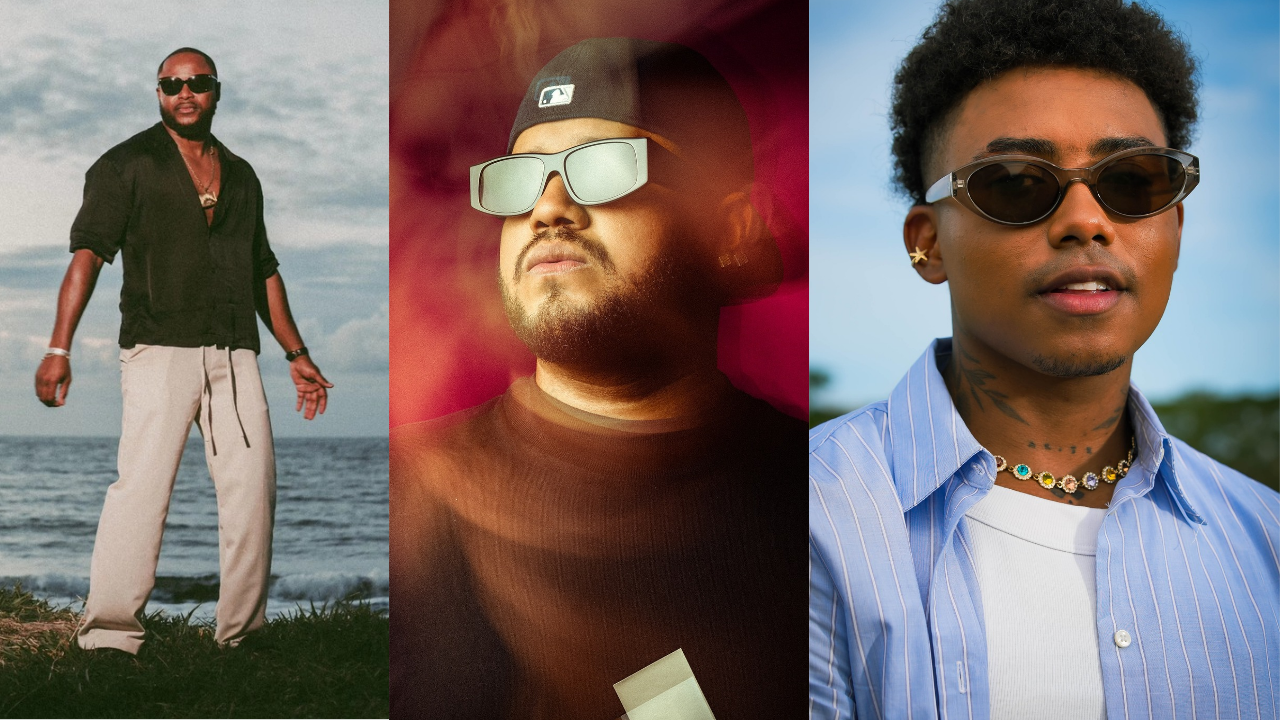

Falz has never sold his masters. Since the earliest record this desk could find, a self-released mixtape from 2009, the phonogram credit on his own catalogue has always carried some form of the name BahdGuys. What has moved underneath that constant, at least four times since 2014, without a single public statement from anyone involved, is who actually carries those recordings to stores and streaming services.
Read the small print under Falz’s releases on Apple Music and Deezer, the line beginning with the ℗ symbol that names whoever holds the sound recording copyright, and the picture gets complicated fast. BahdGuys, spelled four different ways across seventeen years of releases, never disappears. But the name sitting alongside it changes, drops out, comes back, and changes again, and none of it was ever announced.
What the credit line actually says#
This desk read Falz’s full discography through Apple’s catalogue lookup for his artist profile, 161 releases running from the 2009 mixtape “Shakara” to a June 2026 EP, on both the Nigerian and United States storefronts. The results matched on every shared release. Deezer’s separate album catalogue was checked against the same titles as an independent corroborating registry, and MusicBrainz’s release database was checked as a third.

The catalogue opens in 2009 with BahdGuys alone, then goes quiet until January 2014, when four singles in a row carry a different name entirely: Jungle Entertainment Ventures. For the next five years, Falz’s own releases split between the two names with no visible logic. Some carry BahdGuys alone. Others, released in the same stretch by the same artist on what is by every other measure the same imprint, carry Jungle alone. Neither name refers to the other on any release in that period. The first credit to spell out how they relate does not appear until September 2019, on the single “Loving,” where one version of the release reads “BahdGuys Records, under license to Jungle Entertainment Ventures.” Two further singles in 2020 repeat that exact language.
Then Jungle drops out of new-release credits entirely for about eighteen months. When a second company enters the picture in mid-2021, on the singles “Mercy,” “Body Language” and “Oga,” it is not Jungle. It is Dvpper, a separate Lagos distributor, appearing on one version of each release while another version of the same single simultaneously carries BahdGuys alone. By early 2023, on “Owa” and “Yakubu,” BahdGuys and Dvpper finally appear together in a single unified credit line rather than split across two versions of the release. Then, on the same day in August 2023, Jungle Entertainment Ventures reappears, this time explicitly as BahdGuys’ licensee, on two more singles. From mid-2024 through most of 2025, no distributor is named at all. In March 2026, a fourth name appears for the first time, a company called Azuri, credited alongside BahdGuys on the single “Omoge.” The most recent releases in the catalogue, from June 2026, drop the distributor name again and carry BahdGuys alone.
Two registries, and they do not agree with each other or with themselves#
Apple’s own catalogue contradicts itself once, directly. The 2014 album “Wazup Guy” exists as three separate entries in Apple’s own system for what is nominally one release: two credit BahdGuys, one credits Jungle. Nothing in the data explains which one reflects what was actually printed at the time or whether one was corrected later.
Deezer disagrees with Apple twice, in a consistent direction. On both occasions a distributor’s name sits alongside BahdGuys in Apple’s credit line, once for Dvpper in 2023 and once for Azuri in 2026, Deezer’s own label field drops BahdGuys and names only the distributor. That is not true every time a second name appears; when Jungle returns as licensee in August 2023, Deezer’s label field matches Apple’s wording exactly, spelling out the license relationship in full. So Deezer’s registry sometimes corroborates Apple’s compound credits in full and sometimes collapses them down to the distributor alone, and there is no way to tell in advance which behaviour a given release will show.
MusicBrainz adds a third layer of disagreement. Its entry for the 2016 duet “Chemistry” credits neither BahdGuys nor Jungle, the two names Apple and Deezer both associate with Falz’s catalogue in that period, but a completely different pairing: BahdGuys Records and X3M Music. And MusicBrainz’s own database treats “BahdGuys Records” and “B.A.H.D Guys Entertainment Limited,” the spelling in use since 2022, as two entirely separate label entities with different internal IDs, rather than one name that changed over time. Whether that is a MusicBrainz cataloguing choice or reflects something real about two distinct legal entities is not something this desk could resolve from the data available.
One outside mention, and nothing else#
The only independent public document connecting Falz to any of this is not about him specifically. One piece of 2020 reporting on a distributor’s withdrawal from a Nigerian streaming service named Falz directly as one of the artists that distributor served at the time, alongside several other well known Nigerian acts. That is the single moment any of this desk’s sources ties Falz’s name to a distributor relationship outside the phonogram credits themselves. It does not date the relationship’s start, does not describe its terms, and was not followed by any statement from Falz, BahdGuys, or the distributor when the relationship apparently paused a few months later.
What a distribution credit is and is not#
None of this is ownership changing hands. Nothing in any source reviewed suggests BahdGuys ever stopped being the label of record on Falz’s own catalogue, or that Jungle, Dvpper or Azuri acquired, co-owned or took any stake in his masters. A distribution credit records who moves finished recordings into stores; it says nothing about who owns the copyright underneath, and BahdGuys’ name never leaves that underlying credit for more than a handful of releases at a stretch.
What is also missing, across every single one of these arrangements, is any account of its shape. No advance, fee, royalty split, exclusivity term or contract length for any relationship between BahdGuys and any of the three distributors named here appears in any source this desk could find. No agreement date exists for any of the switches either; every date in this record marks when a release carrying a given credit first or last appeared, not when a deal was struck or ended. And BahdGuys itself, despite anchoring seventeen years of one of Nigeria’s most consistent recording catalogues, has no confirmed company filing under any of its four spellings. Nigeria’s company register has no public search interface, and the one aggregator this desk checked returned nothing. The claim that Falz owns BahdGuys rests on a registry’s own description of the label, not on a corporate document or a statement from Falz himself.
What this means for artists#
The lesson in Falz’s catalogue is not that he lost control of anything. On the visible evidence he kept exactly what he has always had: his own name anchoring the copyright line, an imprint that has survived four visible changes of distribution partner without ever ceding the underlying credit. The lesson is in how little of that machinery is ever made visible on its own terms. Four different distribution relationships, unfolding over more than a decade, produced one incidental mention in someone else’s story and otherwise nothing public at all.
For an artist who runs his own label the way Falz runs BahdGuys, that is worth sitting with. Owning the imprint protects the name on the credit line. It does not, on its own, produce a record of who else touches the money that name generates, or when that access started and stopped. The distributor relationship is exactly the kind of arrangement that affects an artist’s reach, advances and streaming payouts day to day, and it is also exactly the kind of arrangement that three different registries cannot fully agree on and that no party involved has ever felt the need to explain. For any artist building a career on an independent imprint, the quiet lesson here is that the paperwork behind a distribution switch is worth asking for in writing, because on the public record, nobody else is going to volunteer it.