
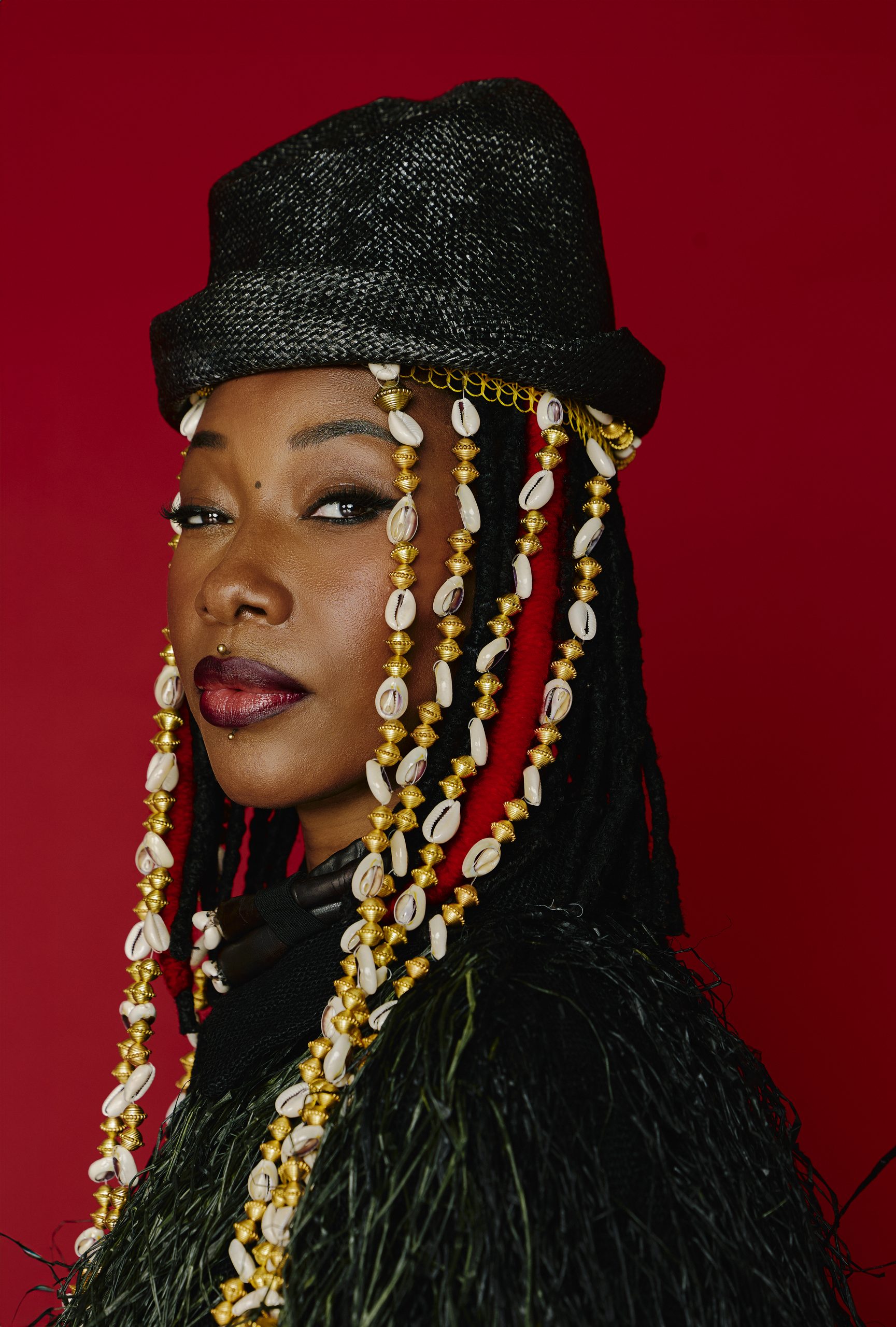
There is a moment in Massa where Fatoumata Diawara stops performing and simply speaks; no ornament, no softening, just a woman naming what she sees. “We need to be honest about our realities,” she says of the album. It is definite, a mission statement.
Everything else about her, the guitar, the voice, the nearly 3-decade-long career spanning film, theatre, and music, has been in service of that same instinct: to look directly at something and refuse to look away. It’s been 27 years since Fatoumata first stepped in front of an audience, not with a guitar, but as an actress, debuting in Cheick Oumar Sissoko’s 1999 feature before music ever found her.
In the decades since, she’s become something closer to an institution: Mali’s first female solo electric guitarist, a bridge between the desert blues of Tinariwen and the pop stages of Paris. Singing almost entirely in Bambara, her native tongue, to audiences that are mostly white, mostly foreign, mostly people who came, as she puts it, “because they know that they will see me as authentically African.” She has never once tried to be anything else for them.

Massa strips all of that history down to its bones. For the first time, there’s no Kora, no Ngoni, no percussion softening the edges, just her voice, guitar, drums, bass, the same lean setup she brings to the stage. “Massa is the story of an accomplished woman,” she says. “ I’m a mum now, not a baby anymore.” It’s an album built in solitude, the way she builds everything: alone with her guitar and her sound engineer before anyone else is let into the room, deciding the melodies, the bassline, the first drums, long before a band arrangement ever touches it.
What comes through, across every answer, is a woman who has stopped asking for permission. She writes for Mali, for the Malian people confronting their own realities, for a continent she refuses to doubt. “I believe in Africa,” she says. “We are the root and origin of everything.” Twenty-seven years into a career built on exactly that conviction, Fatoumata Diawara isn’t chasing anyone’s approval anymore. She’s simply telling you who she already is.
The guitar is the primary instrument in all your projects, and you are also widely known as the first female solo electric guitar player in Mali. What inspired you to start playing the electric guitar?
I’ve been playing the guitar since I began making music. You’ll hear it all over my work; from Fatou to today, it’s always guitar-first. I love the electric guitar especially because it’s easy to travel with.
When I started playing the guitar, it felt perfect to me. In Mali, we got music from the desert, like Tinariwen, that is based on the electric guitar. Our sound in Mali is quite bluesy, a little desert, but it is played on an electric guitar. So it was easy to travel with, and you can play anywhere. You don’t need to tune it.
In the studio, I always play both the acoustic and electric guitar. I play the main songs on the acoustic, then add a second guitar: the electric. The electric guitar is also better on stage because the sound check goes faster. At the beginning of my career, it was very difficult to play the acoustic guitar on stage because it can be a bad experience if you don’t have the best sound engineer.
You’ve collaborated with artists across different genres and continents, including Oumou Sangaré and Angélique Kidjo. How have collaborations shaped you as an artist and also influenced your storytelling? Will we see a Nigerian collaboration in the future?
I actually hope to collaborate with a Nigerian artist in the future. Next year, I’ll be able to focus more on exploring different collaborations.
Collaborations are so important because they help you creatively challenge yourself as an artist. You always learn by collaborating; exploring different styles is important because it opens you and your audience to new sounds. You learn from other artists because they push you out of your comfort zone.
Working with jazz artists, as I’ve been doing with Herbie Hancock, Diddy Bridgewater, and Gorillaz, is a different type of music. Adapting to their style can feel outside my comfort zone, but that discomfort is great for your experience. It also impacts how you compose without losing your authenticity.
You started your career as an actor with your debut acting role in Cheick Oumar Sissoko’s 1999 feature film. Would you ever return to acting?
I was just thinking about this a few days ago. I think I’m finally at a place in my music career where I can explore other artistic passions. I’ve been building my own story within the past decade, focusing on my music, first of all, as a leader, a pioneer, as a musician, and as a songwriter.
I wanted the world to know that I’m not here to joke. I am a female artist representing the entire continent. Now people have understood everything. I’ve clearly communicated my vision for my music and creativity to my audience. It was really important for my albums, especially Massa, to confirm my style, vision, and direction. I’ve achieved that, and I feel fulfilled and happy. I’ve been getting a couple of acting proposals, and I think it’s time to respond.
You’ve bridged cultures and generations singing predominantly in Bambara, your native language; your music is deeply rooted in African culture. You’ve also travelled the world and are currently based in Paris. How do you retain a strong African identity?
You just have to believe in Africa strongly. I believe in Africa. I never doubt this continent. We are the root and origin of everything.
You have to remember that you aren’t making music for money or fame, but also so this continent is well represented. You shouldn’t change who you are just to make people love you. You have to make people love you for who you are. Most of the time, my audience is white. It’s Chinese, it’s American, it’s French, it’s German, it’s Swiss, it’s all over the world. They come because they know that they will see me as an African, and they accept that because of my authenticity.
There is no choice because I never doubt myself. I believe in Africa. I believe in the strength of my continent, the spirit of my continent. I believe in the beauty of all we have. And our diversity and uniqueness, and I try to reflect that in my fashion sense and style, too. I don’t need to copy anybody. I am the blueprint.
If a young African listener discovers Mali through your album, Massa, what do you hope they learn about Mali beyond news reports? What do you hope that non-Bambara speakers take away from the album?
I want them to know that Mali still has a lot to share with the world. And everything is not that dark. There is still light; God is protecting us, and the Malian people still believe in God. They know that he’s guiding us.
My music, as you know, is largely inspired by Malian culture. My guitar is the foundation of my sound. It all comes from traditional music from Mali, which means we already have everything: rock, blues, pop, etc. I want people to realise how strong this continent is.
This album speaks more to the African people. I was speaking to the people back home. Unfortunately, as beautiful as we are culturally, there’s a lot of jealousy and deception, and I explore those topics through my sound, hoping we can fix them in the future.
What part of yourself exists in Massa that wasn’t present in your previous albums? What part of yourself did you have to explore to tap into when making this project?
Compared to the other projects, the major difference is that I didn’t use any traditional instruments from Mali. My previous albums always had the Kora, Ngoni, percussion, and Congas. They are mixed very softly, but they are there. But this time, nothing- just my voice, the guitars, drums, and bass, minimal, like on stage.
That’s the major difference compared to the other albums. Also, I think I sing differently. When I listen to my previous albums, I can hear how young I was.
The way I sing now is totally different. My voice and depth have evolved. Massa is the story of an accomplished woman. I’m a mum now, not a baby anymore. I’ve achieved so much and experienced so much.
I can feel it in my voice: there’s more confidence, more clarity, and more strength. There’s nothing to doubt. It’s a totally different energy.
My creative process is very simple because I always compose the voice and guitar by myself without my musicians. We spend all year together, but when I want to create music, I prefer solitude- just me and the sound engineer creating magic. I need to be alone to create.
The beginning is always me and my guitar. I write all the songs, backing vocals, melodies, first guitars, bass, drums, and tempos. I decide everything first. Then the arrangement with the team comes after.
There’s a lot of storytelling in your music; you are telling your story, the stories of other women, the story of the continent and the country you are from. What can contemporary African musicians learn from traditional storytellers and griots about preserving culture?
Honesty. We need to be honest about our realities. I addressed many familial issues in Massa. I come from a polygamous home; my father had four wives, and when I talk about it in my music or on TV, I get told to keep quiet, even though we are suffering the consequences of the polygamous situation even after he passed. How can we change our society for the better if we refuse to confront our problems? In Mali, I’m the first person talking about these kinds of issues.
Polygamy has destroyed a lot of families. Music and art should be honest and raw. When my father passed, it was so hard for me. I could see the reality of how people approached things with jealousy. I needed to close the door to clarify through this album. Now everybody knows that I know each of them. I know everybody.
The new generation must wake up. If we really want to build up Africa faster, we must face our realities. Sing for the change of your continent, not just to appeal to a Western audience. We need to show reality. We have to be authentic.
My album speaks more to Malian people than to Western audiences. Most of my audience isn’t African, yet when I write, I write for Africa. I want to represent Africa authentically. I want people to know about this continent and my country, Mali. I want respect for the art, culture, and creativity that this continent produces.
In Tati Bakri, you pay homage to your father and musical forerunners. If your ancestors could listen to your music, what do you hope they will recognise in it? And also what cultural memory do you hope survives through your voice for the future generation?
I want dignity and love for traditional music to be preserved through generations. I want traditional and indigenous music to be on par with any type of music in the world. I pay my respects to the ancestors through my music; I love and respect them, and I hope they are proud of me.
Your email address will not be published. Required fields are marked *
Save my name, email, and website in this browser for the next time I comment.