
Egypt held 47.0 to 57.4 per cent of Spotify’s African export column on 16 September 2026, and which end of that range is right depends entirely on whether a single first-time entrant, a Guinean artist charting only in Italy, is counted. Either way it is far above the 6.4 per cent Egypt held five weeks earlier. Angola sits in the same denominator and cannot be read free of that question either: its share reads 13.9 or 17.0 per cent depending on the same choice, a fall from 12 September under both. What does not depend on the choice is the stream count behind it, a real decline from 52,844 to 47,489, 10.1 per cent, not the disappearance an earlier pass at this dataset wrongly showed.
This is measured across seven collection dates between 13 August and 16 September 2026, grouping every artist in this desk’s African export column (chart streams earned outside Nigeria, Egypt, Morocco and South Africa, the four markets Spotify publishes a daily African chart for) by country of origin and tracking each country’s share of the column’s total. A note on what went wrong in an earlier pass at this same data, and how it was caught, follows the counter-reading section below.
Per cent of that date's total export streams earned by Egyptian-origin artists. The 16 September point is the lower end of a 47.0 to 57.4 per cent range; see the counter-reading.

Show the numbers
| Date | Egypt's share, % |
|---|---|
| 2026-09-12 | 55.70 |
| 2026-09-06 | 48.50 |
| 2026-09-16 | 47 |
| 2026-09-04 | 32.90 |
| 2026-08-28 | 25.10 |
| 2026-08-30 | 21.90 |
| 2026-08-13 | 6.40 |
Source: Computed from this desk's african-export-footprint (13 Aug), african-export-column-composition datasets for 28, 30 August, 4, 6 and 12 September, and the corrected african-export-column-composition-16-september-2026-corrected dataset, retrieved 17 Sep 2026 · download the data
| # | Date | Total export streams | Countries represented | Top country | Top country's share, % | Egypt's share, % | Angola's share, % |
|---|---|---|---|---|---|---|---|
| 1 | 2026-08-13 | 455,051 | 7 | GH | 25.90 | 6.40 | 14.50 |
| 2 | 2026-08-28 | 443,922 | 6 | EG | 25.10 | 25.10 | 11 |
| 3 | 2026-08-30 | 498,043 | 6 | ST | 23.10 | 21.90 | 11.30 |
| 4 | 2026-09-04 | 332,224 | 5 | EG | 32.90 | 32.90 | 16.10 |
| 5 | 2026-09-06 | 261,405 | 3 | EG | 48.50 | 48.50 | 23.20 |
| 6 | 2026-09-12 | 280,159 | 3 | EG | 55.70 | 55.70 | 18.90 |
| 7 | 2026-09-16 | 340,960 | 4 | EG | 47 | 47 | 13.90 |
Source: Computed from this desk's african-export-footprint (13 Aug), african-export-column-composition datasets for 28, 30 August, 4, 6 and 12 September, and the corrected african-export-column-composition-16-september-2026-corrected dataset, retrieved 17 Sep 2026 · download the data
A rising share, then an ambiguous reading#
The export column did not start as an Egyptian story. On 13 August, seven countries split 455,051 export streams and Ghana held the largest share, 25.9 per cent, with Egypt a minor contributor at 6.4 per cent. The top spot changed hands twice more, to Egypt on 28 August at 25.1 per cent, then to São Tomé on 30 August at 23.1 per cent, before Egypt took it back on 4 September and has held it on every date since. Egypt’s own share dipped once, from 25.1 to 21.9 per cent between 28 and 30 August, then rose on every date after that through 6 September (48.5 per cent) to a peak of 55.7 per cent on 12 September, before the ambiguous 16 September reading this piece leads with.
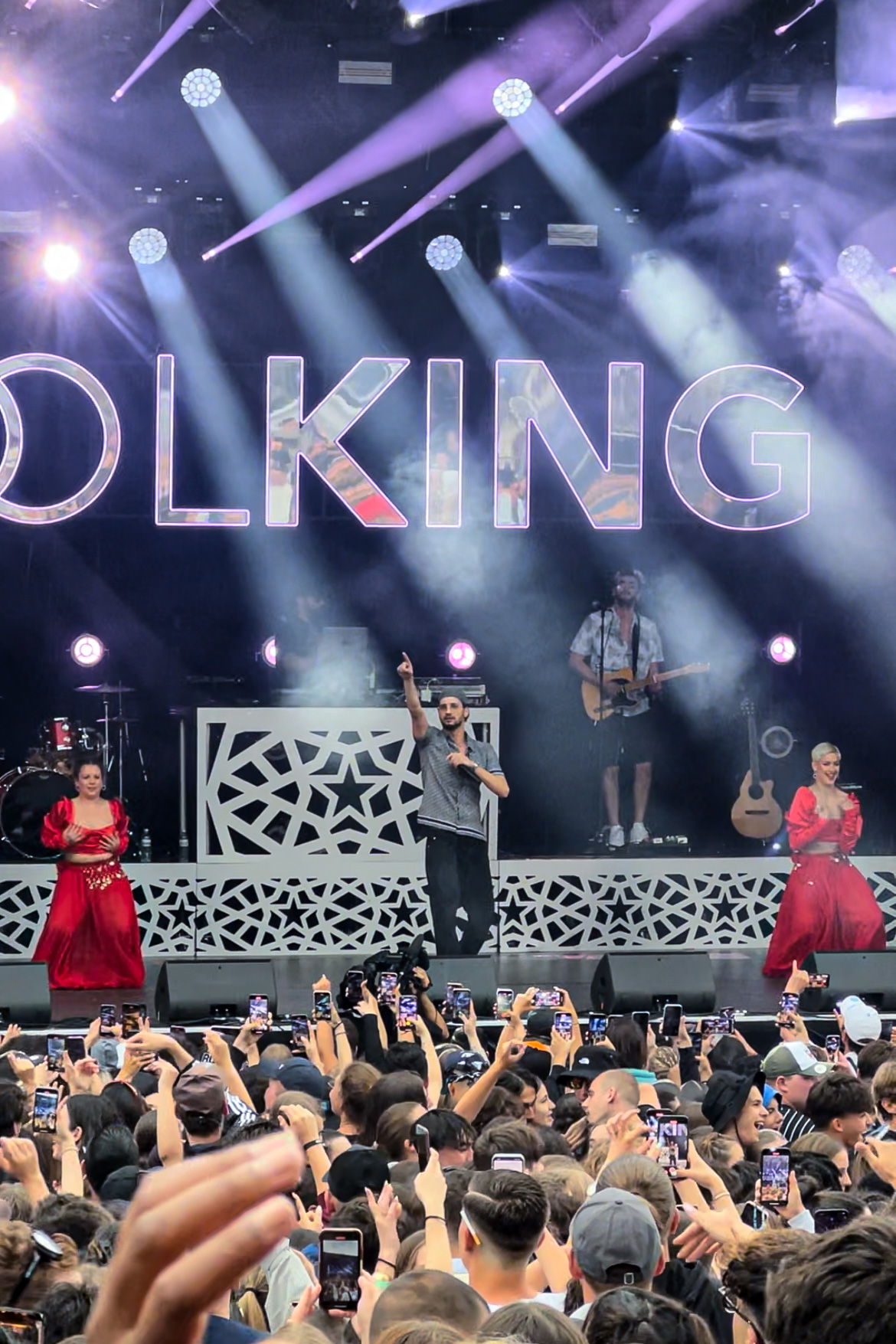
That rise, at both ends of the range, is not one artist’s work. On 16 September the export column carried twelve artists from four countries: seven Egyptian, two Algerian, two Angolan and one Guinean. Egypt’s largest single contributor, TUL8TE, earned 68,319 of the day’s export streams, 20.0 per cent of the column, but six further Egyptian names, Ramy Sabry, Cairokee, Sherine, Mohamed Hamaki, Marwan Pablo and Amr Diab, each carry a share of their own in the table below. Seven artists charting outside Africa on the same day, not one release, is what has carried Egypt’s share since early September, and that count of seven is true under either reading.
| # | Artist | Country | Export streams | Share of export column, % | Export markets |
|---|---|---|---|---|---|
| 1 | TUL8TE | EG | 68,319 | 20 | 1 |
| 2 | Soolking | DZ | 67,406 | 19.80 | 1 |
| 3 | Nabi | GN | 62,001 | 18.20 | 1 |
| 4 | Ramy Sabry | EG | 38,935 | 11.40 | 2 |
| 5 | Anselmo Ralph | AO | 37,338 | 11 | 1 |
| 6 | Cairokee | EG | 15,279 | 4.50 | 1 |
| 7 | Sherine | EG | 11,590 | 3.40 | 1 |
| 8 | Mohamed Hamaki | EG | 10,696 | 3.10 | 1 |
| 9 | Marwan Pablo | EG | 10,646 | 3.10 | 2 |
| 10 | Master Jake | AO | 10,151 | 3 | 1 |
| 11 | Amr Diab | EG | 4,781 | 1.40 | 1 |
| 12 | Noura | DZ | 3,818 | 1.10 | 1 |
Source: Computed from this desk's spotify-african-artists-global and spotify-african-share-by-market datasets, collected 16 September 2026, retrieved 17 Sep 2026 · download the data
Angola’s two artists, Anselmo Ralph and Master Jake, both charting only in Portugal, have appeared on every one of the seven collection dates in this series without exception, including 16 September. Their combined streams fell from 52,844 on 12 September to 47,489 on 16 September, a 10.1 per cent decline that holds regardless of how Nabi’s row is treated, since it is a raw stream count, not a share. The share itself is not immune to the same question that divides Egypt’s reading, because Nabi’s streams sit in Angola’s denominator too: including him, Angola’s share fell from 18.9 to 13.9 per cent; excluding him, it fell from 18.9 to 17.0 per cent. Either way Angola did not leave the column and did not vanish, as an earlier pass at this dataset wrongly showed.
The counter-reading#
The Egypt figure’s exact value on 16 September rests on one editorial question: does Nabi, a first-time entrant charting only in Italy on 62,001 streams, belong in the denominator alongside the eleven artists who were already exporting. This desk resolves his origin to Guinea on published biographical evidence, and his classification is not disputed; the question is only whether a brand-new entrant’s arrival should be read as diluting Egypt’s share or as a separate event.
| # | Scenario | Artists | Total export streams | Egypt export streams | Egypt's share, % | Angola export streams | Angola's share, % |
|---|---|---|---|---|---|---|---|
| 1 | Including Nabi (16 September as collected) | 12 | 340,960 | 160,246 | 47 | 47,489 | 13.90 |
| 2 | Excluding Nabi (first-time entrant) | 11 | 278,959 | 160,246 | 57.40 | 47,489 | 17 |
Source: Computed from african-export-column-composition-16-september-2026-corrected, retrieved 17 Sep 2026 · download the data
Include Nabi, as the column was actually collected, and Egypt’s share reads 47.0 per cent, a fall from 12 September’s 55.7, while Angola reads 13.9 per cent. Exclude him, treating his 62,001 streams as outside the comparison because he was not present on the prior date, and Egypt’s share reads 57.4 per cent, a continued rise, while Angola reads 17.0 per cent. This desk publishes the collected figures, 47.0 and 13.9 per cent, as the primary reading because Nabi’s streams are real and his classification is not in question, but the 10.4-point gap on Egypt’s reading, and the 3.1-point gap on Angola’s, are each larger than the fall they sit inside, and a reader who wants “is Egypt still rising” or “how far did Angola fall” answered with confidence should not get it from this single date’s share alone. Angola’s stream count, unaffected by either reading, answers the second question on its own: down 10.1 per cent.
The wider series carries its own sensitivity. Running the same test this desk applies to every headline column on the full seven-date series shows how concentrated Egypt’s rise is in time, regardless of the Nabi question.
| # | Scenario | Rows | Mean | Largest row share, % | Change in mean, % |
|---|---|---|---|---|---|
| 1 | All rows | 7 | 33.93 | 23.45 | 0 |
| 2 | Excluding the top 1 (2026-09-12) | 6 | 30.30 | 26.68 | -10.70 |
| 3 | Excluding the top 3 (2026-09-12, 2026-09-06, 2026-09-16) | 4 | 21.58 | 38.12 | -36.41 |
| 4 | Excluding the top 5 (2026-09-12, 2026-09-06, 2026-09-16, 2026-09-04, 2026-08-28) | 2 | 14.15 | 77.39 | -58.30 |
Source: Recomputed from african-export-column-country-composition-series-corrected, retrieved 17 Sep 2026 · download the data
Drop the three highest-value dates, 12, 6 and 16 September, and the mean across the remaining four falls from 33.9 to 21.6 per cent, a 36.4 per cent move: for most of this series Egypt was a large contributor, not close to a majority holder, and the last three readings alone carry the finding. The same test applied to the 16 September artist table shows the concentration is not only Egyptian: drop TUL8TE alone and the collected total falls 20.0 per cent; drop the top three artists, TUL8TE, Soolking and Nabi, and it falls 58.0 per cent.
| # | Scenario | Rows | Total | Largest row share, % | Change in total, % |
|---|---|---|---|---|---|
| 1 | All rows | 12 | 340,960 | 20.04 | 0 |
| 2 | Excluding the top 1 (TUL8TE) | 11 | 272,641 | 24.73 | -20.04 |
| 3 | Excluding the top 3 (TUL8TE, Soolking, Nabi) | 9 | 143,234 | 27.18 | -57.99 |
| 4 | Excluding the top 5 (TUL8TE, Soolking, Nabi, Ramy Sabry, Anselmo Ralph) | 7 | 66,961 | 22.82 | -80.36 |
Source: Recomputed from african-export-column-composition-16-september-2026-corrected, retrieved 17 Sep 2026 · download the data
Two further limits. First, this column measures chart streams outside four African-charted markets inside Spotify’s published daily charts, not an artist’s total streaming outside Africa; an artist who charts nowhere still exports plays this measure cannot see. Second, origin classifications were fixed at whatever this desk’s roster held on each collection date rather than backdated, so a roster correction made after a date was collected does not move that date’s total retroactively; the seven totals in this series are not built from an identical roster snapshot.
What an earlier version of this piece got wrong, and how it was caught#
The first version of the 16 September dataset was built from this desk’s top-50 africa-global panel, which silently dropped three artists, Anselmo Ralph, Master Jake and Noura, who had carried export streams on every one of the previous six dates but do not place in the top 50 by global daily streams. That version showed Egypt at 55.3 per cent and rising, and Angola at zero. Both were artefacts of a population that had quietly narrowed between one collection date and the next, not a finding about Egypt or Angola. This desk’s own numbers gate passed that draft, because the gate matches prose to cited datasets and cannot see that a dataset’s underlying population changed between rows. The error was caught in this piece’s required second reading, by summing this desk’s spotify-african-share-by-market totals for every non-African market carrying an African artist on 16 September (Saudi Arabia, France, Portugal, Italy and the United Arab Emirates) independently of the artist-level composition table; the two sums disagreed by exactly the streams the missing three artists carried. The corrected datasets used throughout this piece restore the full export population and are registered separately from the originals so the difference is auditable.
What this means for artists and independent labels#
Read “African music is breaking out globally” claims for which country is actually doing the breaking out before repeating them. Right now that claim is substantially an Egyptian claim under either reading: seven Egyptian artists hold the largest share of a twelve-artist column. An Egyptian label or distributor with an artist charting abroad is not an outlier this month, they are the base case.
If your artist’s export presence rests on one or two markets, the way Anselmo Ralph’s and Master Jake’s rests on Portugal, do not assume a stable share is a permanent one: their combined streams fell 10.1 per cent in four days without either artist leaving the chart, and their share fell further still, to 13.9 or 17.0 per cent depending on how a single unrelated new entrant is counted. And if you are the one measuring a market like this, check a composed total against an independently built total before publishing it, and state plainly when a single new entrant can flip your headline’s direction, as Nabi’s arrival does here. A dashboard that reports only “47.0 per cent, down from 55.7” without that sentence is reporting a fact and hiding a coin flip.