
The most revealing detail in Shallipopi’s account of his dispute with Dapper was almost an aside. He said that at the time a distribution contract was put in front of him, he was already distributing his own music through DistroKid.
An artist with a hit had solved distribution by himself, for a few dollars a year, before any company offered to solve it for him. That is the fact the Nigerian label business now has to negotiate against, and every public dispute of the past four years has made the artist’s side of that negotiation stronger.
What a 19-year-old with a hit has been watching
Consider what the current crop of upcoming Nigerian artists has learned by observation, without reading a single contract.

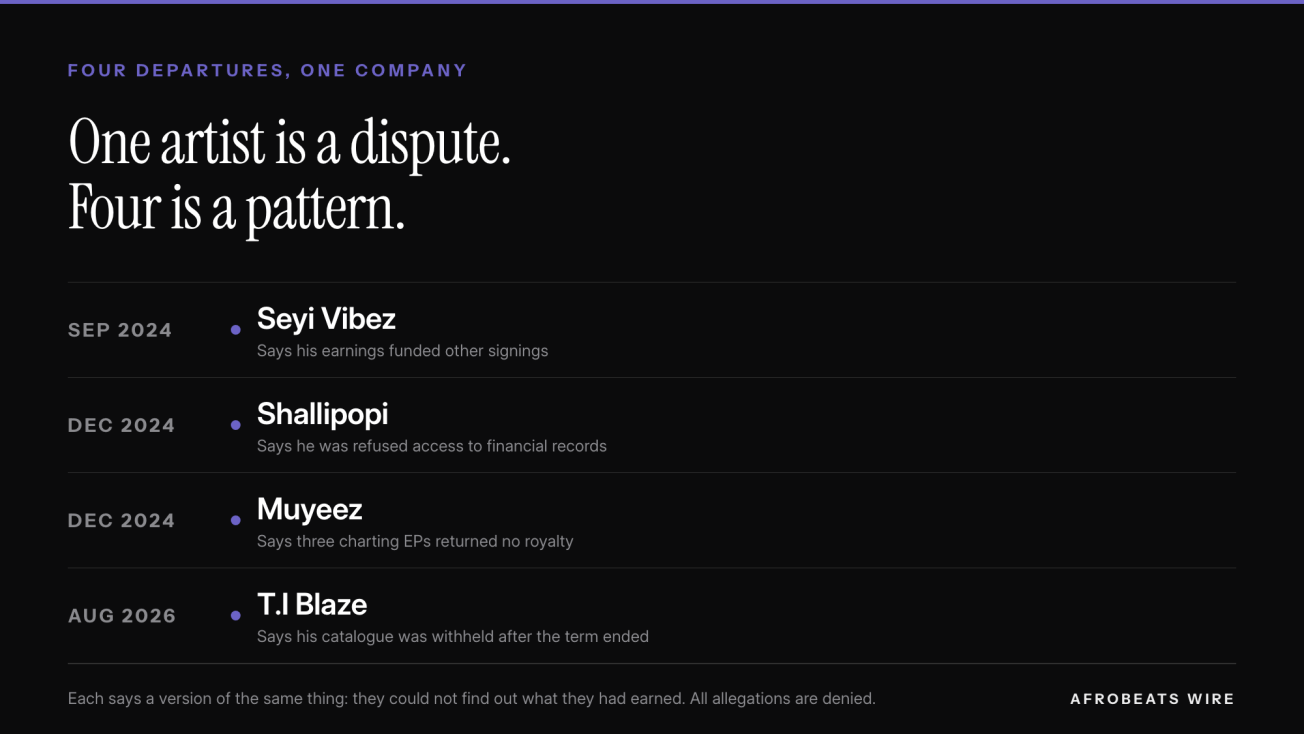
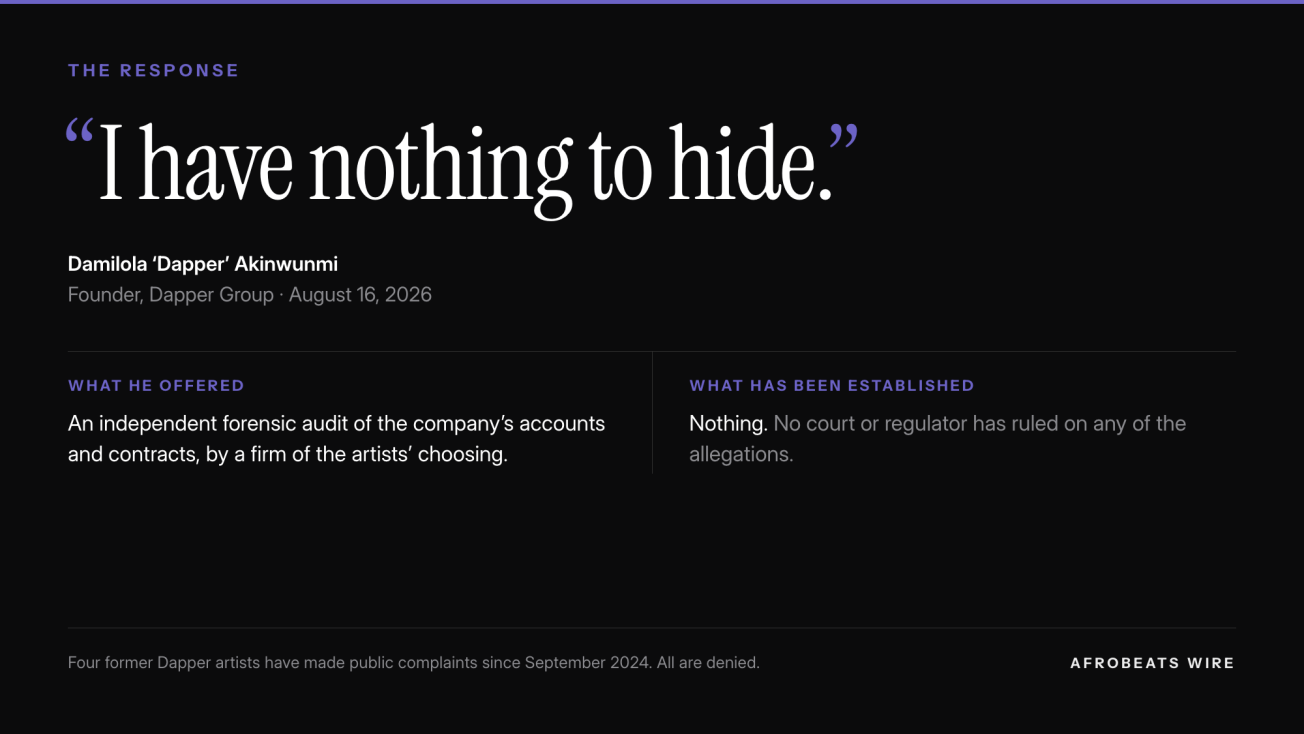
In 2022, Mohbad terminated his agreement with Marlian Music, his lawyers citing royalties unpaid since 2019. His death the following year turned a contract dispute into a national argument about how labels treat the artists who make them money. The P-Square litigation put a decade of accounting between brothers into open court. In December 2024, Muyeez left Dapper Music saying he had received no royalties from three EPs that charted. Now four former Dapper artists have made convergent public complaints about the same company, and the company’s answer, that the artists should nominate an auditor, is an answer nobody heard until the accusations were already trending.
Not one of those cases has produced a public finding of wrongdoing. It does not matter. The lesson being taught is consistent regardless of who is eventually proved right: the deal is the place where the money becomes impossible to see. A young artist does not need a verdict to draw that conclusion. Four cautionary tales are enough.
The reflex is rational, and it is still expensive
Self-releasing is now the default posture, and for the individual artist deciding this week, it is a defensible one. The danger is in mistaking a defensible personal choice for a healthy industry.
Labels do things a distribution subscription does not. They advance money before revenue exists. They buy radio, video, playlist campaigns and physical presence in markets the artist has never visited. They carry the cost of a tour that loses money for two years so that it can make money in the third. Nigeria’s global run over the past decade was built partly by companies willing to spend against an unproven asset, which is what a record label is for.
Remove trust from that arrangement and the capital does not become fairer. It goes somewhere else, or it goes underground.
Artists who will not sign anything scale at the speed of their own cashflow, which favours whoever already has money and quietly closes the door on whoever does not. That is a regressive outcome dressed up as independence. Artists who stay suspicious of Nigerian companies but sign with a foreign one they cannot afford to sue have not reduced their risk, they have moved it somewhere harder to reach. And investors looking at Nigerian catalogues price the uncertainty in. A catalogue whose ownership can be publicly contested on X is worth less than one whose paperwork is boring. That discount is paid by every artist in the market, including the overwhelming majority whose deals are clean and whose labels pay on time.
This is the real cost of the Dapper dispute, and it lands on people with no part in it. The honest Nigerian label now pays for the reputation of whichever company behaves worst.
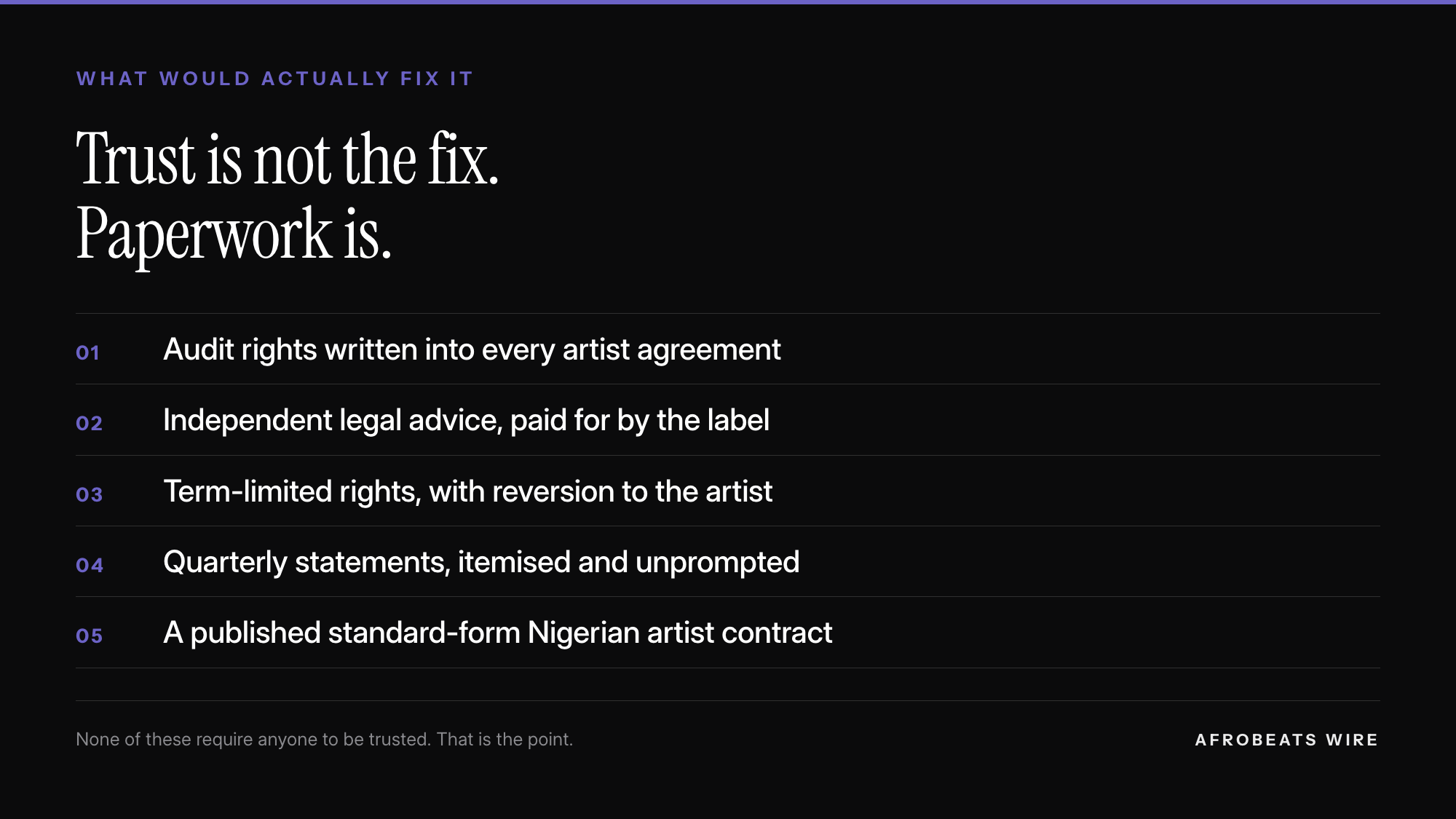
Trust is not the fix. Paperwork is
The temptation is to appeal for better behaviour. That will not work, because the artists who have been burned are not being irrational and cannot be talked out of a correct observation. What can change is the document.
Five things would do more for confidence in Nigerian labels than any amount of public assurance:
- An audit right in every artist agreement. Notice period, independent accountant of the artist’s choosing, a defined window, and the label pays the cost if the audit finds a discrepancy above an agreed threshold. This is standard practice in major markets and its absence is the direct cause of the Dapper dispute being fought in public.
- Independent legal advice as a condition of signing, paid for by the label. A label that will not fund a lawyer for the person on the other side of its contract has told you something about the contract.
- Term-limited rights with reversion. Masters returning to the artist after a defined period, rather than assignment in perpetuity to a company the artist may not be working with in three years.
- Statements on a schedule, unprompted. Quarterly, itemised by track and by platform, delivered whether or not the artist asks. Every distributor on earth can already produce this file. Withholding it is a decision, not a limitation.
- A published standard-form agreement from a Nigerian industry body, so that an artist with one hit and no lawyer has something to measure an offer against.
None of that requires anyone to be trusted. That is the point. Afrobeats became Nigeria’s most successful cultural export while running on relationships, informal understandings and the assumption that everyone would behave. It has outgrown that. An industry at this scale is held together by clauses, and the clause that matters most is the one that lets an artist check the numbers without having to accuse anybody of anything first.
Read next: the four contract structures at the centre of the Dapper dispute, and Dapper’s response to the allegations.