
Spotify’s African chart footprint fell to 7 markets on 30 September 2026, a new low across the 32 collection dates this desk has measured since 13 August. That count is the number of Spotify’s 75 published daily Top 200 charts, worldwide, that carried at least one stream credited to a lead artist whose registered country is African, on this desk’s roster.
Spotify daily Top 200 charts, 75 markets, African origin from this desk's MusicBrainz-resolved roster.
Show the numbers
| Date | Markets with any African artist |
|---|---|
| 2026-08-13 | 12 |
| 2026-08-24 | 12 |
| 2026-08-17 | 11 |
| 2026-08-20 | 11 |
| 2026-08-21 | 11 |
| 2026-08-22 | 11 |
| 2026-08-31 | 11 |
| 2026-08-27 | 10 |
| 2026-08-28 | 10 |
| 2026-08-30 | 10 |
| 2026-09-02 | 10 |
| 2026-08-25 | 9 |
| 2026-09-01 | 9 |
| 2026-09-04 | 9 |
| 2026-09-07 | 9 |
| 2026-09-06 | 8 |
| 2026-09-12 | 8 |
| 2026-09-13 | 8 |
| 2026-09-14 | 8 |
| 2026-09-15 | 8 |
Source: kworb.net Spotify daily country charts, artist origin from MusicBrainz, retrieved 30 Sep 2026 · download the data

The count had not moved in fifteen straight readings. From 12 September to 28 September it sat at exactly 8, the previous floor in the series, first reached on 6 September. Thirty September is the first time it has gone lower. The drop is not spread across the panel: it is one market, and the mechanism behind it is one artist.
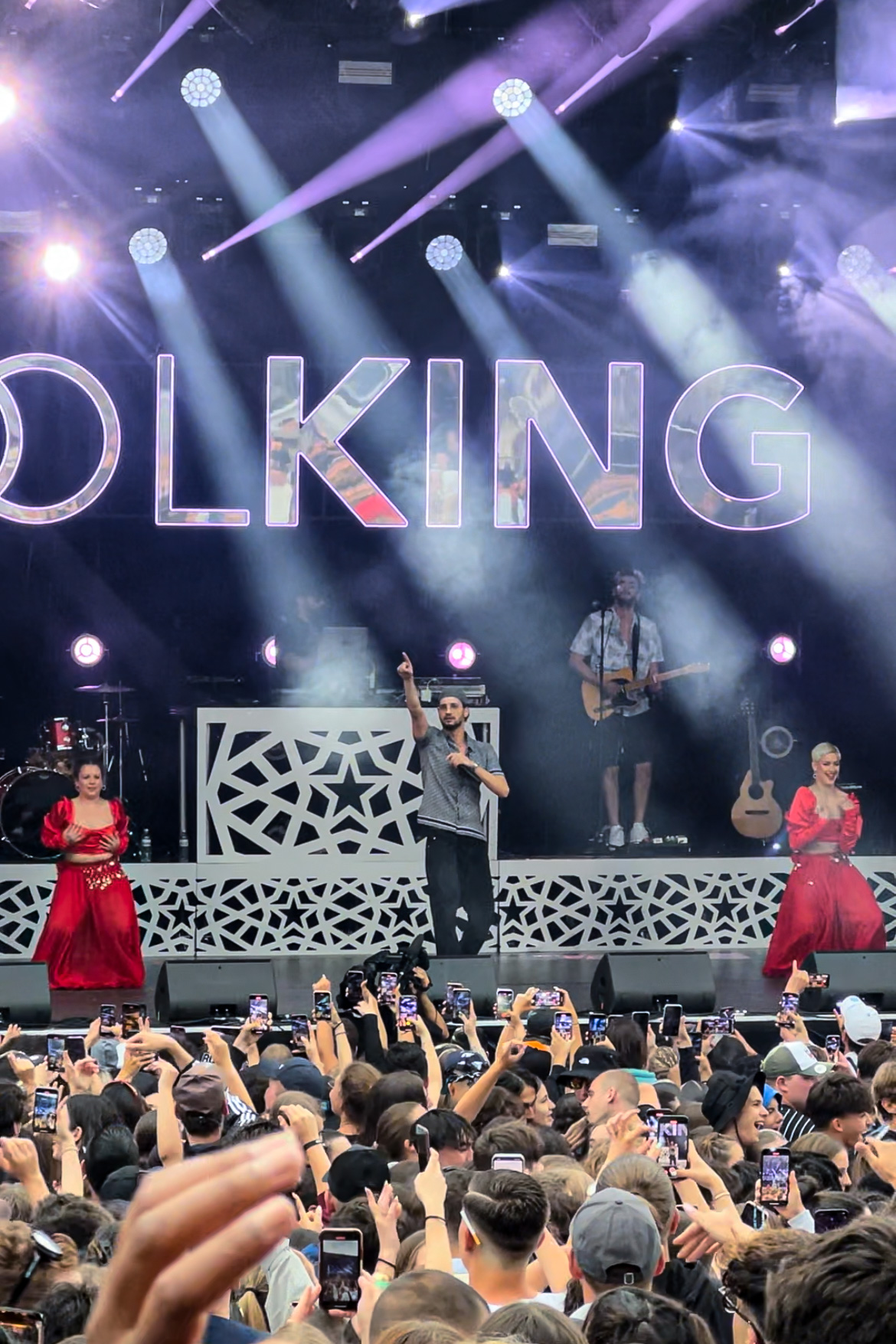
That market is France. On every prior reading this desk has on record, France’s sole African-origin representative was a single artist: the Algerian rapper Soolking, charting under his own name with one track, nowhere else. Algeria has no Spotify daily chart of its own, so a France-only footprint was already the entire shape of his export presence. On 28 September he still held 70,969 streams there. By 30 September he is absent from France’s Top 200 altogether, and so, with him, is every African-origin artist France’s chart carried.
France was not the only single-artist market in the panel. Four days earlier, Italy’s sole African-origin entrant, an artist charting there as “Nabi,” dropped out of the roster for a different reason: this desk’s own anomaly check found the MusicBrainz record behind that Spotify ID actually belongs to an Italian-French rapper, not the Guinean artist the panel had assumed, and reclassified the row out of Africa entirely. Between the 24 September and 28 September readings, Italy’s single-artist presence was removed by correction rather than by the chart. The effect on the footprint count was the same either way: a market held up by exactly one artist stopped counting.
| # | Market | African share % | African chart streams | African artists charting |
|---|---|---|---|---|
| 1 | NG | 81.63 | 10.54m | 34 |
| 2 | EG | 75.92 | 4.69m | 31 |
| 3 | MA | 45.17 | 912,361 | 25 |
| 4 | ZA | 16.40 | 739,479 | 22 |
| 5 | SA | 12.27 | 129,337 | 7 |
| 6 | PT | 1.08 | 32,144 | 2 |
| 7 | AE | 2.72 | 17,917 | 3 |
Source: kworb.net Spotify daily country charts, artist origin from MusicBrainz, retrieved 30 Sep 2026 · download the data
What is left after both single-artist markets failed is a panel with more depth, even if it is narrower. Every one of the 7 remaining markets now carries at least 2 African-origin artists: Portugal, the thinnest, has 2; Nigeria, the thickest, has 34. Nigeria (81.63 per cent African by chart streams), Egypt (75.92 per cent) and Morocco (45.17 per cent) are the desk’s four home charts alongside South Africa (16.4 per cent), and between them they still account for the overwhelming majority of everything the panel measures. Saudi Arabia (12.27 per cent), the United Arab Emirates (2.72 per cent) and Portugal (1.08 per cent) are what remains of reach beyond those four borders, none of it built on a single act anymore, but none of it large either.
That last point is the honest limit on how much the footprint number should be allowed to mean. A leave-one-out check on the same panel shows how little volume sits outside the top markets: with Nigeria removed, the total falls 61.77 per cent; with Nigeria, Egypt and Morocco removed, it falls 94.62 per cent; with the top five markets removed, 99.71 per cent of the measured streams are gone.
| # | Scenario | Rows | Total | Change in total, % |
|---|---|---|---|---|
| 1 | All rows | 75 | 17.07m | 0 |
| 2 | Excluding the top 1 (NG) | 74 | 6.52m | -61.77 |
| 3 | Excluding the top 3 (NG, EG, MA) | 72 | 918,877 | -94.62 |
| 4 | Excluding the top 5 (NG, EG, MA, ZA, SA) | 70 | 50,061 | -99.71 |
Source: Recomputed from spotify-african-share-by-market, retrieved 30 Sep 2026 · download the data
So the footprint count and the stream total are measuring different things, and they just moved in opposite directions for the same reason. Losing France cost the panel a market but essentially no streams, since France’s entire African-origin volume was one artist’s chart tail. That is exactly why the count is worth tracking on its own: it is the only one of this desk’s numbers that answers “how many places,” rather than “how much,” and a market can matter to that question while being financially irrelevant to every other one this desk publishes.
For an independent artist or label reading this as a signal of where Spotify’s charts might open up next, the honest reading is that they mostly have not, in either direction. Genuine footholds beyond the four African home charts are still limited to three markets, none of them carried by more than a handful of tracks, and the two beachheads that depended on a single artist have both now closed within the same week. An artist banking on a chart entry outside Africa translating into a durable market presence should treat that entry as provisional until it survives at least a few readings without the one track that produced it. On this panel, neither of the last two artists to hold that position managed it.