
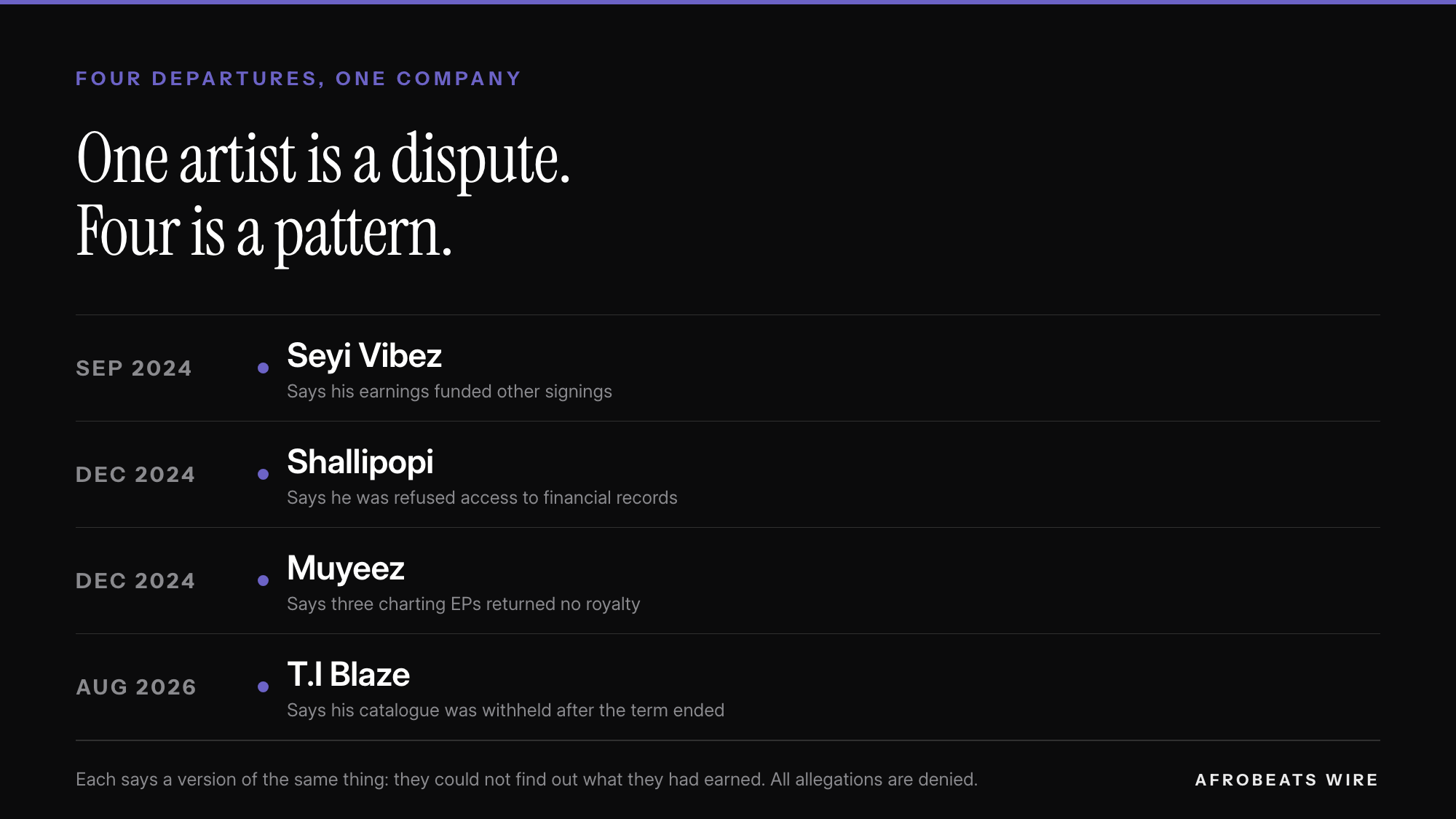
One artist falling out with a label is a dispute. Two is a coincidence. Four former Dapper artists, making the same complaints, in the same order, across two years, is a pattern, and it deserves to be examined as one.
Seyi Vibez left in September 2024. Shallipopi and Muyeez both left that December. T.I Blaze went public on August 14, 2026. They signed at different times, at different stages of their careers, with different levels of leverage. They are not friends acting in concert, and two of them have had public friction with each other. What they have in common is the company they signed to and the shape of what they say happened next.
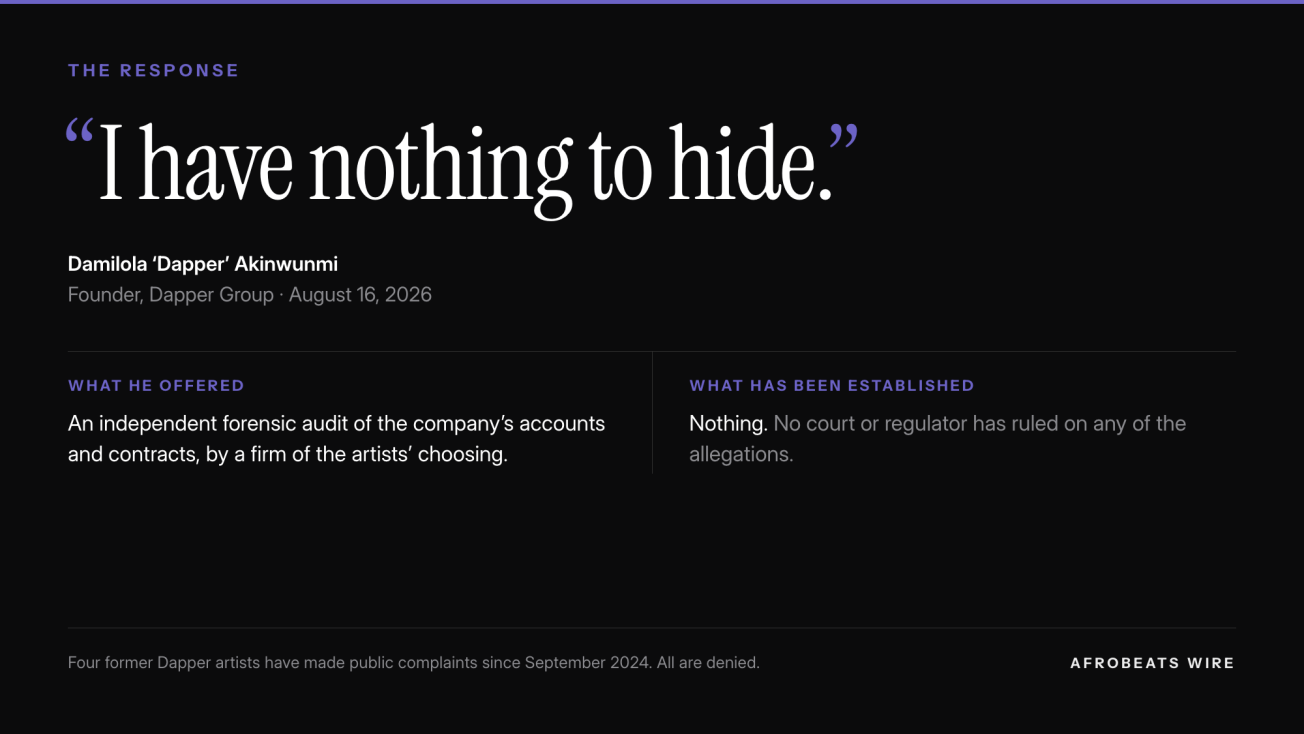
Damilola “Dapper” Akinwunmi denies the allegations and has invited the artists to nominate an independent auditor. The specific accusations of forgery and theft remain unproven, and this article does not treat them as established. But the contract structures the four artists describe are not in dispute at all. Several of them are published by the company itself. Those structures are worth naming, because they are the part that can be fixed.

1. One group sits on both sides of the table
Dapper Group was founded in 2018 and now runs, by its own account, Dvpper Digital for distribution, Dapper Music & Entertainment as the flagship label, S94 Publishing, Dapper Live and Dapper Films. A single artist can therefore be managed, signed, distributed, published, booked and filmed by subsidiaries of one holding company.
Sold as a pitch, that is a full-service operation and a real advantage in a market with few of them. Read as a negotiating position, it means an artist facing a question about money is facing the same counterparty at every point where that question could be asked. The manager whose job is to challenge the label’s accounting reports to the person who owns the label. The distributor who calculates the payment is owned by the party that pays it.
Muyeez named exactly this in December 2024, saying the company acted as his management while also being the label, which left him without anyone independent looking after his interests. Dapper Music denied his account of the signing, saying his father had signed on his behalf with witnesses present. Note what that denial answers and what it does not. It addresses who held the pen. It does not address who was representing the artist.
2. The catalogue does not leave when the artist does
T.I Blaze says his contract expired, that he spent around seven months seeking a private resolution, and that his catalogue still has not been released to him. Shallipopi says his catalogue was moved into a Virgin Music Group arrangement without proper accounting to him.
This is the point at which most artists discover that a recording agreement and a copyright assignment are two different things. The term ends on a date. The rights, in many Nigerian deals, do not end at all. An artist can be free to sign elsewhere tomorrow and still not own a single master they made. Nothing about that is illegal. It is also almost never explained to a young artist at the moment of signing, and it is the single most valuable clause in the document.
3. The revenue tail that outlives the relationship
When Shallipopi announced his exit in December 2024, he said he had been presented with an arrangement that would have taken 30 per cent of his earnings even after the relationship ended, and that advances had been raised against his name and catalogue without his knowledge.
Post-term participation is not automatically abusive. A label that has spent real money on an unrecouped artist has a legitimate interest in recovering it. It becomes indefensible when it is open-ended, and when the artist cannot obtain a statement showing what is left to recoup. Without that statement, the clause is not a repayment schedule. It is a permanent claim.
4. Nobody agreed in advance who gets to count the money
This is the thread that runs through all four accounts, and it is the one that matters most.
Shallipopi says he asked repeatedly for access to financial records. T.I Blaze asks how roughly 1.2 billion naira went unexplained. Muyeez says he received no royalty at all from three EPs that charted. Seyi Vibez says his earnings were used to fund the signing of other artists. Strip out the amounts and the accusations and the same sentence is left in every case: I could not find out what I had earned.
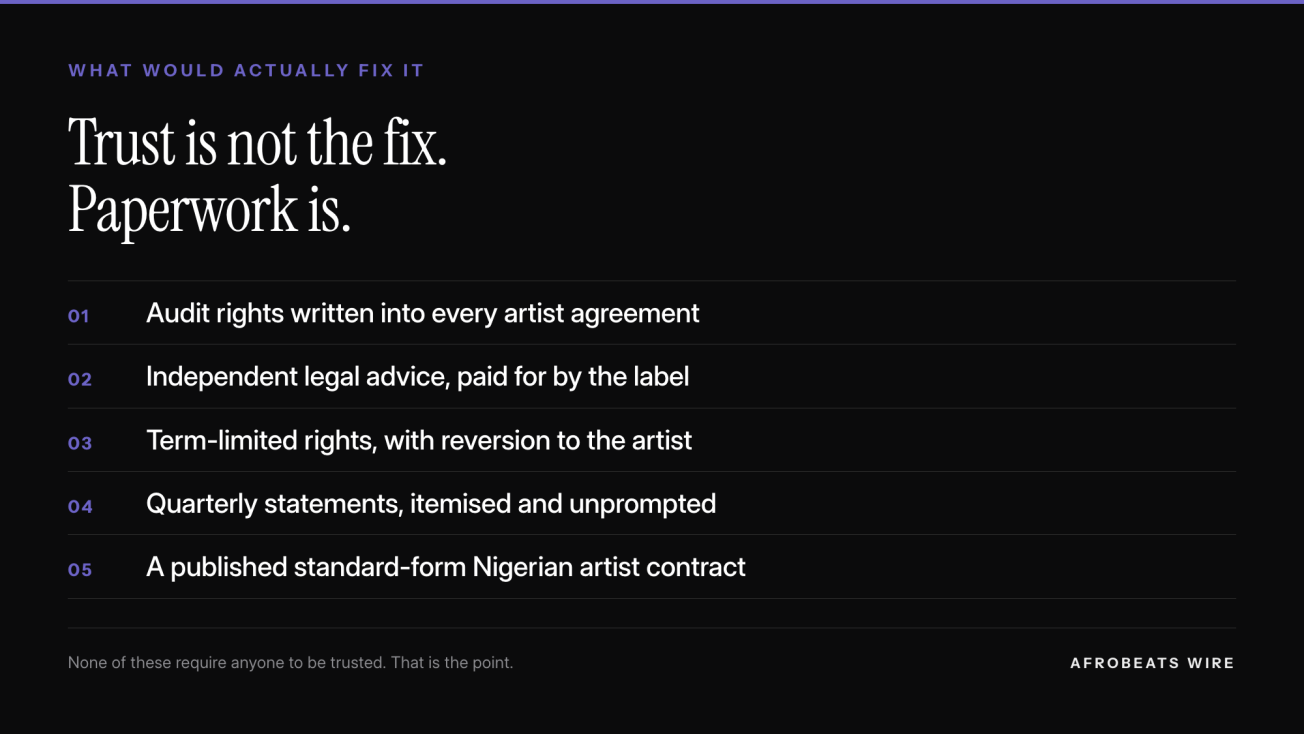
An artist who cannot audit cannot be reassured, and a label that cannot be audited cannot be exonerated. That is why this dispute is being conducted on X instead of in a conference room. Akinwunmi’s offer of an independent forensic audit is the correct instrument, and it should be taken up. But it arrives in August 2026, after four public departures, on the company’s initiative, at a moment of maximum pressure. An audit right written into the original contracts would have made every one of these arguments a procedure rather than a scandal: notice period, independent accountant, defined window, and the label paying the cost if a discrepancy above an agreed threshold is found. That clause is standard in deals signed in London and New York. It is largely absent from the street-pop signings that built this era of Nigerian music.
Why the pattern is the story
A company can be unlucky once. It can be misunderstood twice. When four artists who signed at different times leave describing the same experience, the reasonable inference is not that four people independently invented the same complaint. It is that they encountered the same system.
That inference does not convict anyone of forgery, and it should not. It does establish something the company has not yet answered: whatever the accounting eventually shows, Dapper built a structure in which an artist had no practical way to check the numbers, and then signed young artists into it. That is a choice about how to run a business, and it is a fair thing to hold a company to, separately from whether any naira went missing.
The burden now sits with the documents. The signed agreements, the distribution statements, the Virgin Music Group agreement and the audit Akinwunmi says has already been completed would answer most of this within a week. All of them exist. None of them are public.
What we are not reporting
The dispute has generated personal allegations involving health, relationships and spiritual practice, some of them concerning people who are not party to any of these contracts. Afrobeats Wire is not repeating them. They cannot be verified, they are unfair to third parties, and they tell a reader nothing about how the money moved.
Read next: why upcoming Nigerian artists have stopped signing anything, and the company’s full response in Dapper Denies Artists’ Claims, Offers Records for Independent Audit.