Nine of the 50 artists on Spotify’s African panel earned any streams at all outside Africa on 22 October 2026. The other 41 earned none. Nigeria, which holds 20 of the 50 seats and 62.16 per cent of the panel’s streams, placed none of them on a chart outside Africa, and neither did Morocco or South Africa. The panel’s entire export column, 257,690 streams, belongs to three countries: Egypt, Algeria and Cameroon. Two artists from the last two of those, with one charting track each, hold 48.4 per cent of it between them.
The measurement is a single day across every daily Top 200 chart Spotify published, 74 markets, covering the 50 African-origin lead artists with the most streams on them: 15,534,573 panel streams in total, of which 257,690, or 1.66 per cent, were earned on a chart outside the four African markets Spotify publishes a daily chart for.
Nine artists. The other 41 on the panel recorded exactly zero. Export means a stream on a chart outside Egypt, Morocco, Nigeria and South Africa.

Show the numbers
| Artist | Streams earned outside Africa |
|---|---|
| Soolking | 62,895 |
| Dinos | 61,707 |
| TUL8TE | 56,656 |
| Ramy Sabry | 29,990 |
| Marwan Pablo | 14,579 |
| Mohamed Hamaki | 10,918 |
| Cairokee | 10,417 |
| Amr Diab | 6,535 |
| Sherine | 3,993 |
Source: kworb.net Spotify daily country charts, artist origin from MusicBrainz and this desk's registered overrides, retrieved 22 Oct 2026 · download the data
Nigeria is the panel, and none of its 20 panel artists export#
The country table is the finding. Nigeria puts 20 artists on the panel and 9,655,655 streams through it, more than double Egypt’s 4,687,722, and its artists occupy the top four positions by stream volume. Its export column is zero. Not a small number, not a rounding artefact: zero streams on any of the 70 charts Spotify publishes outside Africa, from 20 artists who between them command nearly two thirds of everything this panel measures. That zero is a zero for those 20 artists, and it is worth saying precisely what it is not. It is not a claim that no Nigerian recording charted outside Africa, because this panel examines the 50 largest African-origin artists and no others, a limit dealt with below.
| # | Country of origin | Artists on panel | Panel streams | Share of panel, % | Artists exporting anything | Streams outside Africa | Share of export column, % |
|---|---|---|---|---|---|---|---|
| 1 | NG | 20 | 9.66m | 62.16 | 0 | 0 | 0 |
| 2 | EG | 18 | 4.69m | 30.18 | 7 | 133,088 | 51.60 |
| 3 | MA | 5 | 582,662 | 3.75 | 0 | 0 | 0 |
| 4 | ZA | 5 | 483,932 | 3.12 | 0 | 0 | 0 |
| 5 | DZ | 1 | 62,895 | 0.4 | 1 | 62,895 | 24.40 |
| 6 | CM | 1 | 61,707 | 0.4 | 1 | 61,707 | 23.90 |
Source: kworb.net Spotify daily country charts, artist origin from MusicBrainz and this desk's registered overrides, retrieved 22 Oct 2026 · download the data
Morocco and South Africa do the same thing at smaller scale: five panel artists each, 582,662 and 483,932 streams respectively, no exporting artists between them. Three of the panel’s six origin countries, holding 30 of its 50 seats, are domestically complete and externally invisible on the same day, on this measure and at this depth.
What is left is Egypt, which supplies seven of the nine exporters and 133,088 streams, 51.6 per cent of the column. Egypt’s exporters are also the only ones doing it with catalogue depth rather than a single song. Ramy Sabry carries 23 charting tracks and TUL8TE 15, and both appear on four markets. Their export shares of their own streams are small, 3.3 and 8.9 per cent, but they are earned across a working body of recordings rather than one.
The two largest rows are French residents#
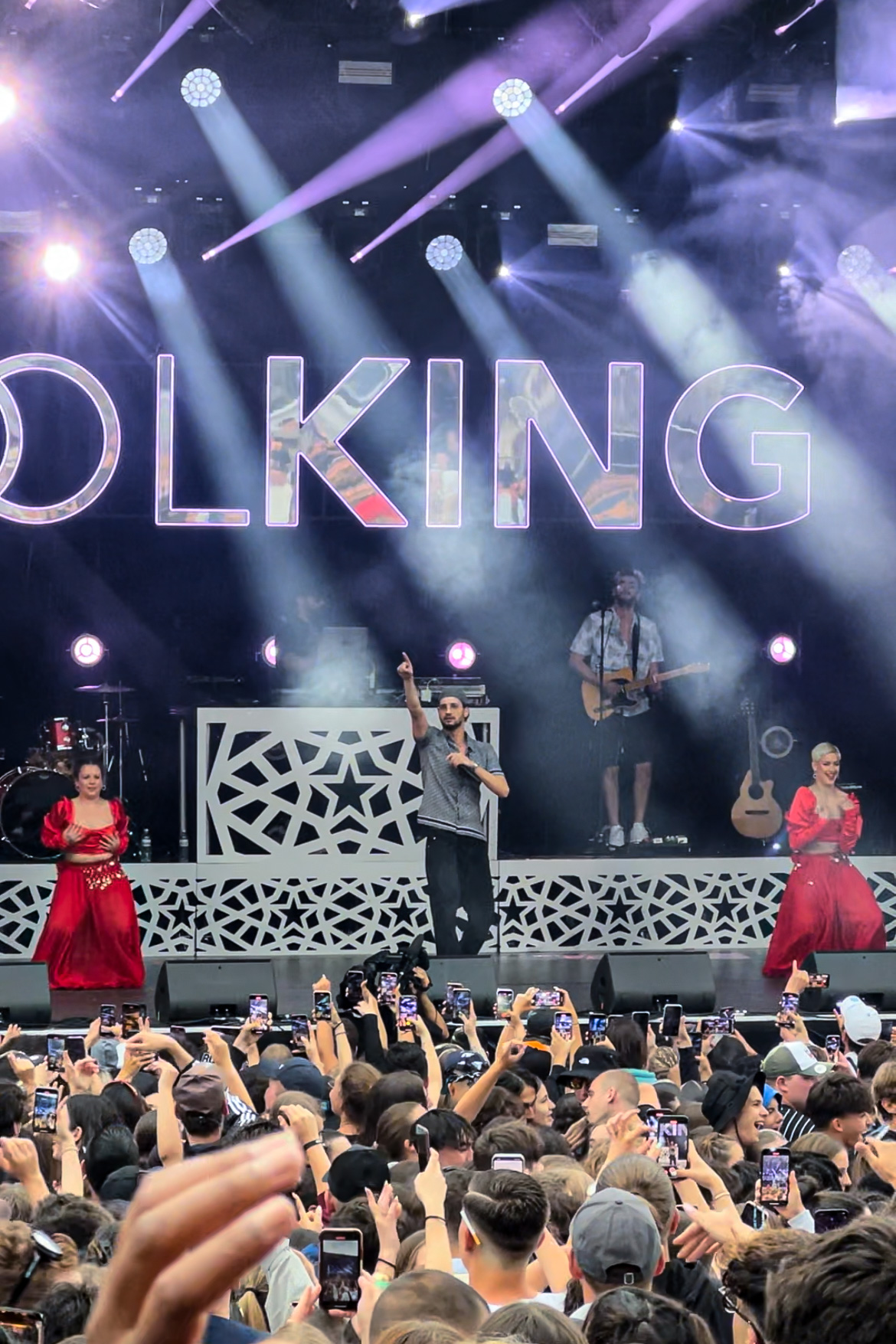
Soolking, registered to Algeria, contributed 62,895 streams, 24.41 per cent of the column, from one charting track in one market. Dinos, registered to Cameroon, contributed 61,707, 23.95 per cent, also from one track in one market. The market in both cases is France, and it is the only market either appeared on. Both are 100.0 per cent export by this panel’s arithmetic, because neither charted anywhere in Africa at all.
Both artists are classified by country of birth, which is this desk’s registered basis. Soolking was born in Algeria. Dinos was born in Douala, Cameroon, on 30 November 1993, and the registry that records that birthplace records his citizenship as French; his family moved to Seine-Saint-Denis when he was six, and his career has been French throughout. Calling his streams on the French chart an export is defensible under the rule this desk applies. It is also the single most load-bearing definitional choice in the whole table.
The counter-reading#
Three things could make this finding say less than it appears to.
The first is concentration, and the leave-one-out test is unforgiving. Removing Soolking alone takes the column from 257,690 to 194,795, down 24.41 per cent. Removing the top three takes it to 76,432, down 70.34 per cent. Removing five of the nine leaves 31,863 across the remaining 45 artists, down 87.64 per cent. A column that loses seven eighths of itself to five rows is not a measurement of a continent’s export performance. It is a measurement of five records.
| # | Scenario | Rows | Total | Change in total, % | Largest row share, % |
|---|---|---|---|---|---|
| 1 | All rows | 50 | 149,068 | 0 | 37.14 |
| 2 | Excluding the top 1 (TUL8TE) | 49 | 93,705 | -37.14 | 32.74 |
| 3 | Excluding the top 3 (TUL8TE, Ramy Sabry, Cairokee) | 47 | 45,544 | -69.45 | 32.92 |
| 4 | Excluding the top 5 (TUL8TE, Ramy Sabry, Cairokee, Marwan Pablo, Mohamed Hamaki) | 45 | 18,278 | -87.74 | 49.17 |
Source: Recomputed from spotify-african-artists-global, retrieved 8 Nov 2026 · download the data
The second is the definition. If France is treated as the home market for the two artists who live and work there, the same stream counts produce a different column: 133,088 streams, down 48.4 per cent, from seven artists in one country. Egypt’s share goes from 51.6 to 100.0 per cent, and African music’s measured export performance on 22 October becomes an entirely Egyptian phenomenon. Nothing in the data changes between those two rows. Only the rule does.
| # | Origin basis | Export column, streams | Artists exporting | Origin countries in column | Egypt's share of column, % | Change vs birth basis, % |
|---|---|---|---|---|---|---|
| 1 | Country of birth (this desk's registered basis) | 257,690 | 9 | 3 | 51.60 | 0 |
| 2 | Country of residence (France treated as home for Soolking and Dinos) | 133,088 | 7 | 1 | 100 | -48.40 |
Source: Computed from this desk's african-export-column-composition-22-october-2026, plus Wikidata residence and citizenship records read for the two affected artists, retrieved 22 Oct 2026 · download the data
The third is the panel’s own edge, and it is the one that genuinely limits the Nigeria claim. The 50-artist panel is not every African artist charting. On the same date the full published series records 110 African artists charting somewhere and an export column of 304,657 streams, against the panel’s 257,690. That leaves 46,967 export streams, 15.4 per cent of the measured column, with the 60 African artists who charted on 22 October without reaching the panel, and nothing in these datasets resolves which countries those 60 come from, because the full 74-market snapshot is pruned to the four African markets once the panel is built.
So the defensible claim is narrower than the loose one. None of the 20 Nigerian artists on the panel earned a charted stream outside Africa, and Nigeria as a whole cannot be cleared or convicted here, because a sixth of the continent’s export column sits in a residual this panel does not open. Readers should treat every country-level zero in this piece as a zero on the 50-artist panel rather than a statement about the country. For the finding as stated to be wrong rather than merely bounded, Nigerian artists outside the top 50 would have to hold a large part of that 46,967, which is possible, unmeasured here, and the first thing the next panel run should settle.
What the series says about whether this is one day#
It is not one day. Across 48 collection dates since 13 August 2026, the export column has sat below its 13 August figure of 380,704 streams on 38 of them, while African music’s share of all charted streams has sat above its 13 August level of 2.158 per cent on 43 of them. Those two counts are deliberately crude, because they do not depend on which pair of days you pick, and a percentage change between two single readings does.
The export column across the full published panel, not just the top 50. It stood at 380,704 on 13 August and 304,657 on 22 October.
Show the numbers
| Date | Streams outside Africa |
|---|---|
| 2026-08-31 | 454,862 |
| 2026-08-24 | 431,972 |
| 2026-08-30 | 424,539 |
| 2026-08-17 | 411,259 |
| 2026-08-20 | 408,314 |
| 2026-08-22 | 401,262 |
| 2026-08-27 | 397,659 |
| 2026-08-28 | 388,000 |
| 2026-09-02 | 385,566 |
| 2026-08-13 | 380,704 |
| 2026-09-07 | 378,153 |
| 2026-09-04 | 370,990 |
| 2026-08-21 | 363,074 |
| 2026-09-01 | 348,844 |
| 2026-08-25 | 337,556 |
| 2026-09-12 | 329,559 |
| 2026-09-13 | 329,424 |
| 2026-09-14 | 306,996 |
| 2026-10-22 | 304,657 |
| 2026-10-04 | 304,263 |
Source: kworb.net Spotify daily country charts, artist origin from MusicBrainz, retrieved 11 Nov 2026 · download the data
Over the same series the number of markets carrying any African artist fell from 12 to 8, while the number of African artists charting anywhere rose from 93 to 110. More artists, fewer countries. The direction of travel on the series is also the reason the day-level robustness matters: the dates with the largest export columns are all in August, so dropping them makes the series total smaller rather than rescuing it. Leaving out the single largest date moves the 48-reading total by 3.13 per cent, and leaving out the largest five moves it by 14.67 per cent, so the series-level picture is not an artefact of one reading either.
What this is not measuring#
Chart presence is not consumption. This panel counts streams that land inside a market’s daily Top 200 and nothing else. A Nigerian artist with substantial listening in London, Houston or Toronto who does not clear the 200th position on those charts registers as a zero here, and that is a real and large blind spot rather than a technicality: a zero in the export column means no charting presence, not no listeners. Spotify also publishes a daily chart for four African countries out of roughly fifty-four, so the African side of this panel is thin by construction, and the four it publishes are not a random sample of the continent.
The panel is one day for the artist-level figures and 48 collection dates for the series, it is the 50 largest African-origin artists rather than all 110 charting that day, origin is country of birth, and every row the classifier flagged on this build was adjudicated against sources read before publication, including the Dinos row, which was checked from scratch precisely because it carries nearly a quarter of the column.
What an artist or label can do with this#
Three things follow that are concrete rather than encouraging.
If you are a Nigerian independent label, the export column says that none of the 20 biggest Nigerian artists by charted volume converted into a foreign chart position on this date, so a chart-based export story is currently worth nothing measurable at the top of the market, and the panel says your home chart is worth 9,655,655 streams a day across 20 artists. That is an argument for pricing international marketing spend against something other than chart position, because chart position abroad is not what your catalogue is currently earning, and for treating any foreign Top 200 entry as a genuinely new line of business rather than an extension of a domestic one.
If you are negotiating on the strength of an export story, the two numbers that matter are in the composition table: the two artists at the top of the column do it with one track each, which is a release, not a footprint. Catalogue depth in the column belongs to Egypt, where 23 and 15 charting tracks sit behind the two largest Egyptian rows. Depth is the thing that survives a record ageing out, and the panel can tell you which of those two you have.
And if you are building a case on diaspora markets, note that 48.4 per cent of the measured column is two artists charting in the country they live in. Diaspora residence and export demand are different assets, they are easy to conflate, and on this panel conflating them doubles the number.
| # | Measure | Value |
|---|---|---|
| 1 | Chart positions published per market | 200 |
| 2 | Artists on the panel | 50 |
| 3 | Artists earning any streams outside Africa | 9 |
| 4 | Artists earning no streams outside Africa | 41 |
| 5 | Artists charting in exactly one market | 41 |
| 6 | Countries of origin on the panel | 6 |
| 7 | Countries of origin with any export streams | 3 |
| 8 | Panel streams, all 74 charts | 15.53m |
| 9 | Export streams, panel | 257,690 |
| 10 | Export streams as share of panel streams, % | 1.66 |
| 11 | Export streams held by the two largest rows | 124,602 |
| 12 | Export streams held by African artists outside the 50-artist panel | 46,967 |
| 13 | African artists charting anywhere but not on the 50-artist panel | 60 |
| 14 | Readings in the panel series | 48 |
| 15 | Series readings with export below the 13 August figure | 38 |
| 16 | Series readings with African chart share above the 13 August figure | 43 |
Source: Computed from this desk's spotify-african-artists-global panel and african-presence-over-time series, retrieved 22 Oct 2026 · download the data