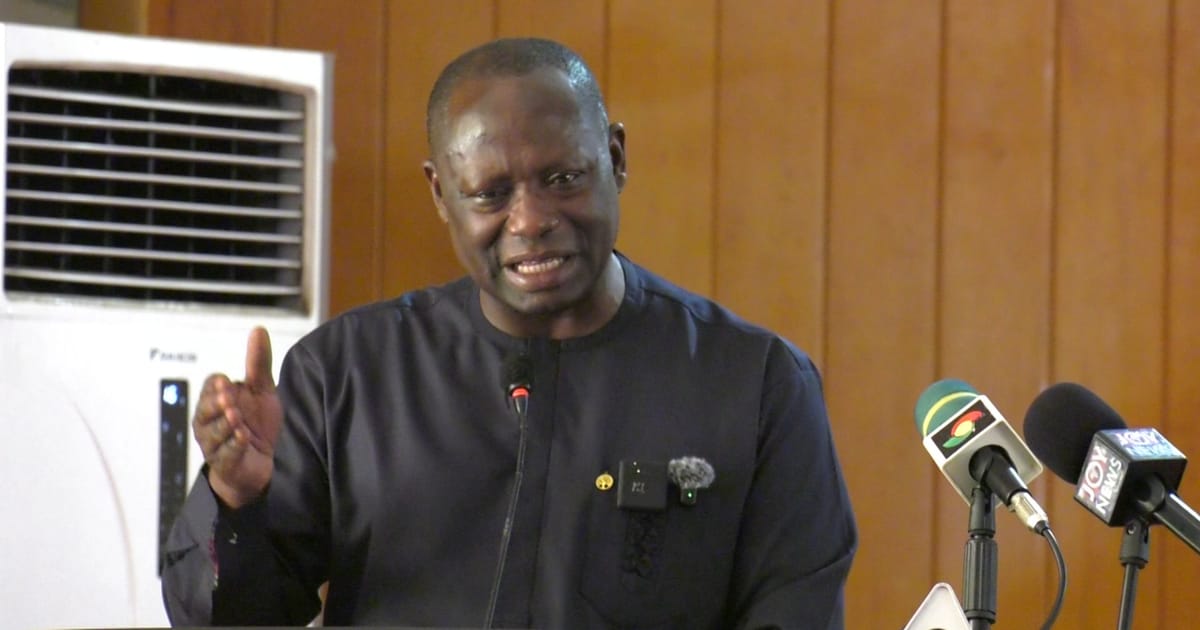
Ghana’s Lands and Natural Resources Minister, Emmanuel Armah-Kofi Buah, says the country’s move to a sliding-scale mining royalty has brought the state an extra GH¢4 billion this year. Royalty receipts have also risen sharply, according to the Minerals Income Investment Fund (MIIF).
He made the claim at the Kwame Nkrumah University of Science and Technology (KNUST) Extractive Summit. He cited MIIF data showing GH¢7.82 billion in royalties received from January to September. All figures are in Ghana cedis (GH¢).
“The Minerals Income Investment Fund has just reported that GH¢7.82 billion in royalty receipts between January and September this year has been received,” he said. “That decision has saved Ghana GH¢4 billion.”
The minister’s remarks, as reported, did not set out how the GH¢4 billion figure was calculated.
Receipts rise sharply#
MIIF’s own figures, released in October, show nine-month receipts were 106 per cent higher than the GH¢3.79 billion collected in the same period of 2025. The fund credited several factors for the increase:
- Higher gold prices
- The sliding-scale mechanism
- Resilient production
- Closer monitoring of mining activity
Large-scale gold mines paid about GH¢7.66 billion of the total, up from GH¢3.54 billion a year earlier. Mid-tier gold producers paid GH¢110.34 million, nearly double the GH¢55.31 million paid in 2025.
Nine-month receipts already exceed the more than GH¢5 billion MIIF collected in the whole of 2025, its highest annual total. The fund is targeting about GH¢9 billion for 2026.
How the new royalty works#
The Minerals and Mining Royalty Regulations, 2025 became law in March. They replaced a flat royalty of 5 per cent with a scale of 5 to 12 per cent that moves with mineral prices.
The rate stays at 5 per cent while gold sells for up to US$1,900 an ounce, and rises in steps as the price climbs. When the rules took effect, gold was around US$5,000 an ounce, which put producers in the 12 per cent band.
Zijin, AngloGold Ashanti and Gold Fields, which hold existing development agreements with the state, are not covered by the new rates.
Armah-Kofi Buah told the summit that under the old flat rate, companies kept paying the agreed royalty even when gold prices rose sharply. They made bigger profits while the state’s take stayed the same. Under the new scale, he said, royalties also fall when prices drop.
Concerns and reactions#
Some international stakeholders had warned that higher royalties would deter investment. Armah-Kofi Buah said the government relied on industry data and international practice, and that mining firms still make reasonable profits.
Gold has not stayed at its peak. In September, analysts flagged weaker gold prices as a risk to the cedi.
When the regulations became law in March, Patrick Boamah, the Okaikwei Central Member of Parliament who chairs Parliament’s Subsidiary Legislation Committee, warned that the policy could cost about a million jobs. “If you introduce this sliding scale, yes, you may accrue some revenue, but the net effect will be some job losses,” he said at the time.
The Ghana Chamber of Mines welcomed Parliament’s cut in the Growth and Sustainability Levy on mining companies, from 3 per cent to 1 per cent. Its chief executive, Dr Ken Ashigbey, said royalties also had to come down for Ghana to stay competitive.
The Ghana Extractive Industries Transparency Initiative (GHEITI) argued that the biggest threat to investment was a lack of fiscal predictability, not necessarily the new royalty itself.
This week, the minister also urged KNUST students to take the lead in the fight against illegal mining.