
Digital music distributors have moved from simple delivery to an enforcement role, deciding what counts as legitimate content on major streaming platforms. A new analysis of five distributors and platform artificial intelligence (AI) policies shows how much that shift now affects independent artists worldwide.
One industry observer, after comparing services, pricing, terms and catalog needs, selected AWAL, owned by Sony Music, citing prior experience running Real Music and a need for trust. That choice came after reviewing digital distribution in 2026, where comparison charts rarely surface the word trust.
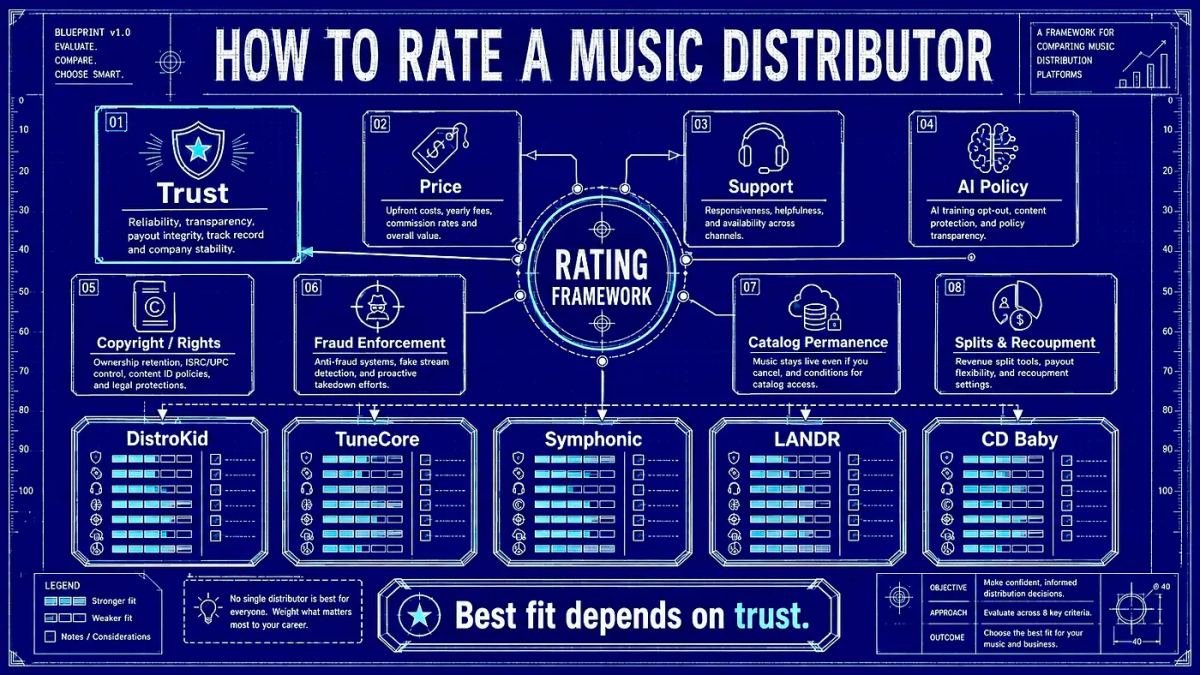
Comparison charts typically focus on cost differences, royalty percentages, automated splits, YouTube Content ID, analytics dashboards and whether Universal Product Code (UPC) codes are included. Meanwhile, artists hand these companies masters, metadata, royalties and, increasingly, the authority to decide whether music is legitimate.
The analysis focuses on five companies with different approaches: DistroKid, TuneCore, Symphonic, LANDR and CD Baby. A separate detailed comparison of 18 digital distributors covers pricing, commissions, features, royalty splits and other measurable variables.
From delivery to enforcement#
For years, distribution meant uploading a WAV file, artwork and metadata, choosing a release date, and waiting for the music to appear on Spotify, Apple Music, Amazon and other services. The process became cheap enough that many independent artists stopped thinking about it.
That was a change from the label, physical distributor, warehouse, manufacturing, sales and funding requirements of earlier eras. An independent artist could place a record on the same digital shelf as major artists for less than the cost of dinner.
But the job has changed. Distributors may now assess whether a recording contains unauthorized AI, whether the uploader owns the material, whether streaming activity looks fraudulent, and whether a copyright claim has merit. They can fingerprint recordings, freeze revenue, reject releases, remove tracks or terminate accounts. Some ask whether AI tools used in production were trained on properly licensed material.
That is a shift from what the analysis calls a company that sends a .WAV file to Spotify. AI is accelerating a change already underway, turning distributors into part of the enforcement layer of the streaming economy.
Platform AI policies diverge#
Major streaming platforms have adopted different rules for AI-generated content.
- Spotify is introducing badges for artist profiles whose public identity appears to be an AI-generated photorealistic person. Those AI Personas are generally excluded from editorial and algorithmic recommendations unless a listener has intentionally engaged with them. The badge concerns who the artist appears to be, not necessarily whether the music itself was AI-generated; Spotify has separate systems for disclosing AI involvement in recordings.
- YouTube asks music partners to classify delivered content as Fully Gen AI, Partly Gen AI or No Gen AI. A bass line generated by AI under human musicians can count as partly AI, while automated mastering does not. If a distributor supplies no AI information, YouTube can use other signals and make its own determination.
- Apple Music has added metadata for AI transparency and will require content providers to tag material where AI created a material portion of the content. Those disclosures are expected to become visible to listeners as “Made With AI” labels later in 2026. Apple is pushing much of the responsibility upstream to record companies and distributors.
- TIDAL identifies and labels recordings it determines are wholly AI-generated, allows listeners to block those recordings, and currently makes wholly AI-generated recordings ineligible for royalties. TIDAL explicitly expects distributors to identify AI-generated content before it reaches the platform.
- Bandcamp does not permit music generated wholly or substantially by AI.
Deezer’s detection push#
Deezer has built a detector. At its June 2026 peak, Deezer says more than 50% of all new music delivered to the platform was fully AI-generated, roughly 90,000 tracks per day. Those recordings represented only about 1% to 3% of actual listening.