
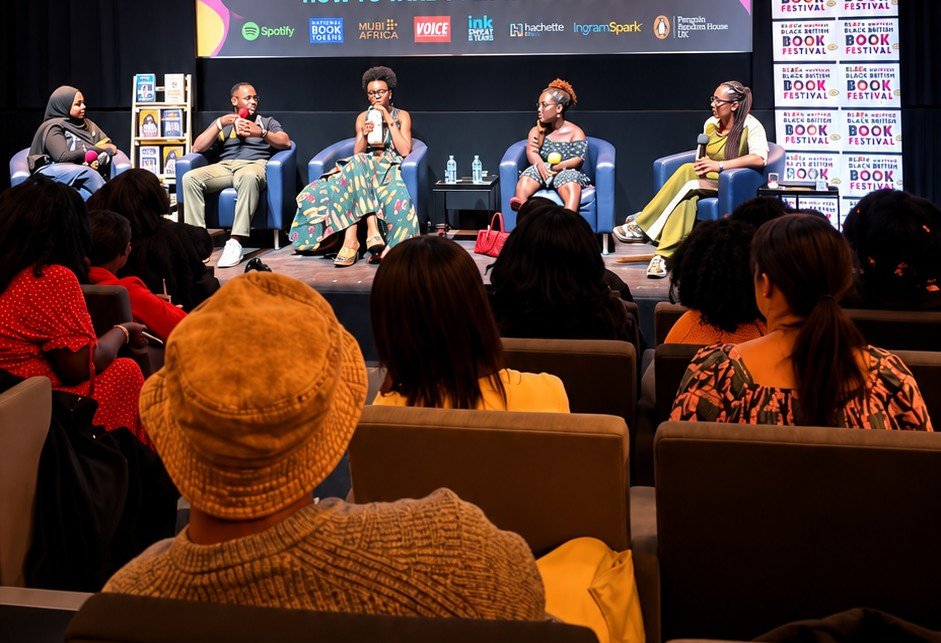
I attended the Black British Book Festival on October 4, 2026, at the Barbican Centre in London. Launched in 2021, the festival was celebrating its fifth edition and its third consecutive year at the Barbican. The organization describes it as Europe’s largest festival dedicated to Black literature. For 2026, more than 80 authors and cultural figures were announced across more than 35 events, drawing thousands of readers, families and publishing professionals.
The program reflected the scale the festival has reached. Candice Carty-Williams, Corinne Bailey Rae, Wretch 32 and Maggie Aderin-Pocock were among the major names announced this year. Literature, music, science, poetry, publishing, workshops for writers and children’s programming shared the different spaces of the Barbican.
But the conversation that particularly caught my attention took place in Frobisher Auditorium 2. Titled Giving Flowers: The Women Who Built Black Publishing, the panel was chaired by Jasmine Richards and was due to feature Verna Wilkins, founder of Tamarind Books, Bibi Bakare-Yusuf of Cassava Republic Press and Valerie Brandes of Jacaranda Books. Valerie Brandes was ultimately unable to attend. The discussion therefore became, above all, a dialogue between two generations of women who built Black publishing infrastructures at a time when there was neither a roadmap nor any guarantee that the wider industry would follow.

Verna Wilkins looked back at the birth of Tamarind in the late 1980s, the absence of Black children from children’s picture books and the need to go directly to readers when traditional bookshops still failed to see them. But what especially held my attention was Bibi Bakare-Yusuf’s vision and the story of Cassava Republic Press.
Founded in Abuja, Nigeria, in 2006, Cassava Republic Press publishes fiction and nonfiction for adults and children and has developed across Africa and the United Kingdom. During the panel, Bibi Bakare-Yusuf reflected on her beginnings in Nigeria, the years in which Cassava Republic’s business plan remained in the red, the importance of building a community of publishers, the role of capital, the economic survival of
Black-owned publishing houses, the Big Five, artificial intelligence and what she calls “the Archive of the Future.” Here are some of the questions that best capture her vision.
BIBI BAKARE-YUSUF: When I started, I was an academic. I had moved to Nigeria to work at a university, and when I visited people’s homes or went into bookshops, I was struck by the books I saw: Rich Dad Poor Dad, lots of motivational books, John Grisham, the kind of literature you find in airports. I kept asking myself: how can you build a civilization on these kinds of texts? How can we build ourselves as a people if we are not reading ourselves, if we are not reading across our differences? So I thought somebody should start a publishing company. I didn’t think that person would be me. I spoke to people who were much more
business-oriented. They asked whether I wanted to do educational publishing or general publishing. I said general publishing. They told me there was no money in it and that I was on my own.
Yes. I don’t really have a head for numbers, so we asked someone to help us. I looked at the business plan and all I could see was red everywhere. For about seven years, everything was red. I asked, “What about the
break-even point? I’ve heard about break-even. Where is it?” There wasn’t really one on the trajectory we wanted to follow. So I thought: let’s put the business plan aside and just start. Let’s see where it takes us. The question that kept occupying my mind was the same: where are the books by Black writers on people’s shelves?
I think it is extremely important that Black people, Africans, wherever we may be, whether in Benin or Bahia, are able to tell our own stories. But that is not enough.
We have to own the instruments through which we disseminate the ideas we publish. Otherwise, we end up in a situation where, during Black Lives Matter, Blackness is in vogue, everyone is interested in us, and then that attention disappears. But we are still here. That is why we need more Black publishing companies.
I would probably tell her to find more investors, people who can de-risk the work, because it is costly financially, emotionally, on every level. I would also tell her to build a community with other publishers. When I started in Abuja, most of the publishers I could speak to were in educational publishing. So I had to find a publishing community in London. We spoke over Skype with Margaret Busby. When I came to London, I would go and see Verna and learn from their experience before taking that knowledge back to Nigeria.
You find other places. Sometimes we put books in hair salons, restaurants, cafés and universities. I come from academia, and I also had this idea that whatever we published needed to enter what I call “the Archive of the Future.” I want someone, five hundred years from now, to open that archive and not find it empty. And if there are books there, I don’t want them to have been produced only by Penguin or Hachette. Even if those books were written by Black people, I don’t want only the Big Five to be represented in that archive. I want to be among those who contributed to that archive of the future.
Because if I have power, I can create all the representation I want. I’m not going to chase representation. I would choose power any day. A lot of Black authors now say, “I can be published by Penguin, Hachette or one of the Big Five.” Then some come back and say, “My book came out and now it’s no longer around.” Of course there is room for the big publishing houses. But we also have to think about the structures that will still be there when the attention has moved on.
Yes. At the back of our books, we tend to credit the people who were involved in making them. The first time we did it, an author called me absolutely furious. They said, “But this is my book.” I said: yes, it is your book, but it is also a production. When you watch a film or buy an album, there are credits. Why shouldn’t we share credit in books too? A book would never be what it is without all these different talents. There is the author, the structural editor, the copy editor, the graphic designer and all these people working together to transform “the raw into the cooked.” Making a book is not a singular act.
I don’t really believe in universality in that way. We have to understand why some things haven’t changed that much between 1989 and 2026: the structures underpinning everything have not changed.
We need children to be able to look in the mirror. But we also need them to be able to look out of the window, because looking out of the window allows us to see others and build empathy. We always start from the local. When we read Sally Rooney, her world is very particular, very local, and it is that local that becomes universal.
I want us to write from our own center. We need to find our center of gravity first. Then other people can participate in that conversation.
When the manuscript came in, I think I read the first five or six pages and thought, “Oh my gosh, I want this book.” We later found out, when it was shortlisted for the Women’s Prize, that the manuscript had been rejected by 54 publishers. For me, that didn’t simply mean there had been 54 blind people. I thought: this is exactly why Cassava Republic must exist. This is why publishing houses like ours must continue to exist.
Look wider. Fifty-four rejections is a lot for the human spirit to hold. Black authors need to spread their wings. Don’t look only at the large or medium-sized publishers. Look around. Maybe a Jacaranda, a Storymix or a Cassava Republic will be able to hold you. We are not perfect. But the publishing house you’re running to isn’t perfect either. We are all trying to find our way through an extremely challenging industry.
More than flowers, more than money: people need to buy the books. The biggest responsibility a publisher has to its authors and its reading community is to remain solvent. And in order to remain solvent, we need to sell books. But this isn’t only about Cassava Republic. We need to support Black publishers. Because when we are no longer part of the public imagination, when the big players no longer see our usefulness, we will still be here for one another. Storymix, HopeRoad, Jacaranda, Cassava Republic… it is us. So we need to support one another and spread the word.
There are enough of us to support them. That obviously doesn’t mean other communities shouldn’t read these books. But if we started with Black people alone, we could remain in business, continue to survive, and it wouldn’t have to be so hard. To a young Black person wanting to start a publishing company today, I would still say: do it. But find support. Find community. And find an investor.
Through sales. It’s simple. It’s mathematical. Publishing is where art and science combine.
Absolutely. There is a whole generation of young people moving back toward analog, moving back toward books. Some things are going to survive, never mind what the tech bros tell us. I think human beings always return to themselves. Among the Yoruba, we have this idea that you can travel all over the world, but you will always come back home. I think it will be the same with books.
Editorial note: This article was built from the interventions recorded during the Giving Flowers panel at the 2026 Black British Book Festival. The questions were structured to create journalistic continuity; the answers are based on Bibi Bakare-Yusuf’s statements during the session, with repetitions and spoken hesitations removed.
December is looking good with these blockbuster movies.
Wale Gbadamosi-Oyekanmi is bringing Nigerian and French artists, producers and creatives together through Lagos feat. Paris.
These brands are turning Africa’s rich craftsmanship into luxury we can’t stop admiring.
By providing your information, you agree to our Terms of Use and our Privacy Policy. We use vendors that may also process your information to help provide our services.