


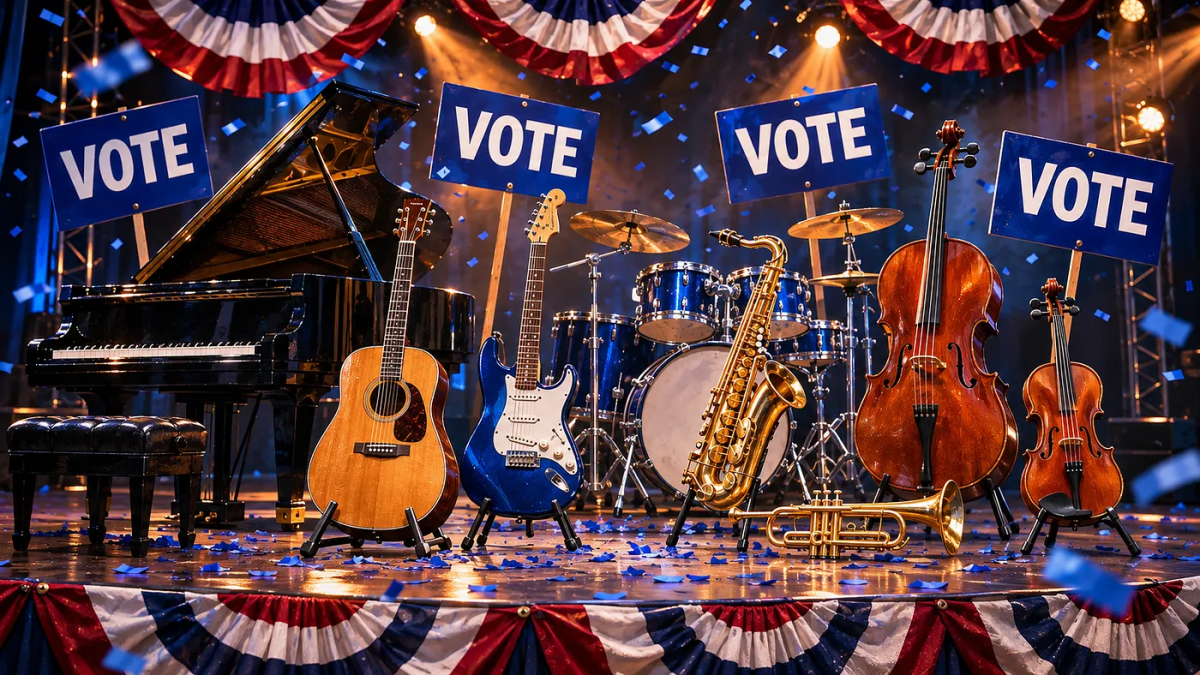
Democrats’ victory in the United States midterm elections gives Congress a chance to change the terms under which artificial intelligence (AI) uses music. Over the next two years, lawmakers could set protections for copyright, a performer’s identity and the money generated from creative work.
Market reaction and outlook#
Financial markets responded quickly. On November 5, the Nasdaq fell roughly 5.5% as investors weighed stricter AI regulation and limits on data-center expansion. The election added to pressure on an AI investment trade already questioned over heavy spending and uncertain returns.
The shift does not mean AI development has slowed, and markets can reverse direction quickly. Investors are, however, beginning to factor in closer scrutiny of the industry.

Training data and copyright#
The author argues that a more deliberate pace could give policymakers time to understand what AI already does and to make better decisions about what comes next. Musicians, in this view, need to know where their work is going, what they are agreeing to and whether they will be paid.
Political limits remain. President Trump holds a veto, Democrats have disagreements among themselves, and several existing proposals have bipartisan support, although sponsorship and passage are different outcomes.
Copyright already governs certain kinds of copying, subject to exceptions including fair use. How those rules apply to specific AI practices is still disputed. Describing a process as “training” does not settle the legal question, and neither does assuming every use of copyrighted material is automatically illegal.
A 2025 case, Bartz v. Anthropic, illustrates the complexity. The judge found the training use at issue to be fair use, but rejected a fair-use defense for acquiring and keeping pirated books in a separate library. Different parts of building the same system produced different outcomes. The ruling was not a nationwide decision on music training.
The author supports a permission requirement for defined commercial uses of protected music in generative-AI training, with carefully drafted exceptions. Congress would need to address both the composition and the sound recording, because permission for one does not necessarily cover the other.
Senator Marsha Blackburn’s broader AI discussion draft proposes excluding unauthorized AI training from fair use. The change would be significant, and its scope needs close examination.
A workable rule would let copyright owners decide before a use takes place, and would give developers a clearer basis for budgeting and product development. At present, the author argues, too much depends on who can afford to keep litigating.
Access to training records#
Enforcing a right is difficult when the other party holds the records. A musician who hears a commercial system produce music closely resembling their catalog may not be able to prove their recordings were used, let alone that infringement occurred.
Several proposals address this gap:
- CLEAR Act: would require disclosures about covered copyrighted works in training datasets.
- TRAIN Act: would create a subpoena process allowing owners to obtain records about their own material.
Neither measure would automatically establish infringement. Both would help answer the basic question of what happened. The author suggests Congress build on them with record-retention requirements and independent audits, with sensitive information kept confidential but available to qualified investigators or a court.
The author also says the CLEAR Act’s coverage is too narrow. It generally limits its definition to registered works and certain older recordings, while much music is protected without registration. Those works, the author argues, should be included in any useful transparency system.
Performer identity and likeness#
The author argues that law should separate ownership of a recording from control over a performer’s identity. A company may own a master recording, but that does not fully answer whether it can create new performances using a singer’s voice. Protections vary across US states, leaving performers with different options depending on the circumstances.
The NO FAKES Act would establish federal voice and likeness protections and a process for addressing unauthorized replicas. Its progress has exposed disagreements over free speech, and reporting, criticism, parody and other protected expression would need room to operate.
According to the author, the protection should extend to session singers whose voices have professional value even when most listeners do not know their names. It should also include a practical removal process, since a lawsuit that takes years offers little immediate help when a fake performance is circulating.
The author adds that the framework should leave room for musical influence. Copyright generally does not give anyone ownership of a style, and protecting a singer against unauthorized replication differs from giving an artist control over a genre, production approach or familiar musical vocabulary.
Contracts and consent#
A strong identity right could still be weakened by the contracts musicians sign, the author says, which makes specific and informed consent essential. A session agreement should not quietly authorize unrelated synthetic performances for years. Uploading a recording through a distributor, a digital service provider (DSP), should not leave open what else a company may do with it.
California’s restrictions on certain digital-replica contract provisions and the sound-recording protections of SAG-AFTRA (Screen Actors Guild-American Federation of Television and Radio Artists) are cited as useful examples. Their reach, however, depends on how the rules apply to specific cases.