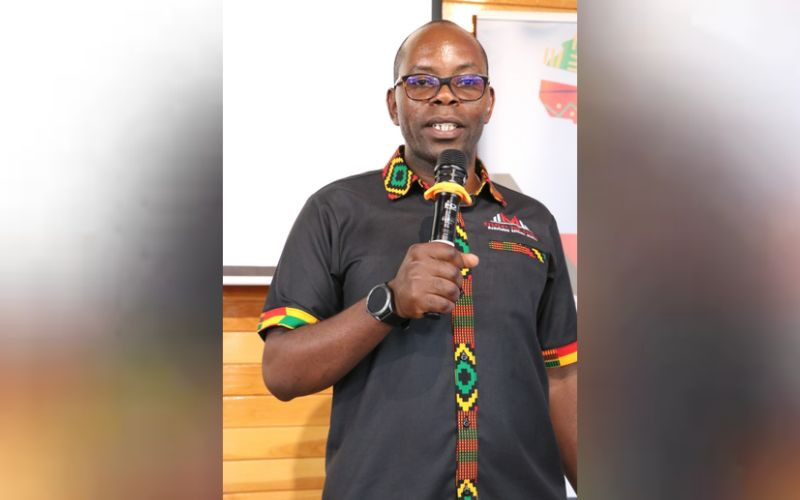
Mystery Publishers Limited, a Kenyan firm, marks its tenth anniversary with a model built on one principle: authors keep ownership of their work, including copyright and subsidiary rights.
An author-owned model#
Founder Vincent de Paul says every author the firm has worked with owns their book outright, “copyright in their own name, every right attached to it, undivided.” The firm was registered on September 16, 2016, and has published 70 titles by debut authors without claiming ownership of them.
De Paul describes the author as the publisher in this arrangement. “They commission us the way you would commission an architect,” he says. Authors pay for editing, design, printing and distribution, and they retain their rights and production files.
The firm says it has never borrowed money, accepted donor funding or built up unsold stock, and that it relies on freelancers.
“We will not fail because we published a bad book. We will fail with a store full of good ones and a printer’s invoice we cannot meet,” he says.
Selective acceptance and the founding story#
Although the firm offers self-publishing services, it does not accept every manuscript. “We are not a print shop. We turn manuscripts down. Where our name appears on a spine, it means the work met an editorial standard.”
“Paying us buys professional work. It does not buy our endorsement,” de Paul says.
De Paul says he started the firm because he could not find a publisher for his own manuscript. Several houses rejected it, citing the limited market for poetry or its absence from the school syllabus. He eventually gave up and left the manuscript unpublished, and he came to see that many writers faced the same problem.
“It dawned on me: nobody was going to publish any of them, and when those people died, their stories were going to die with them.”
Kenya’s publishing market and readership#
De Paul believes Kenya’s publishing industry has been weakened by its reliance on schoolbook procurement. “The Kenyan publishing industry was organised almost entirely around school procurement. To me, that was not literature, but a supply chain.”
He disputes the claim that Kenyans do not read, pointing to newspapers, scripture, WhatsApp forwards and social media. He argues that reading is treated as an exam chore rather than a pleasure, and that book prices compete with household needs.
The firm has published authors from:
- Nigeria
- Rwanda
- South Africa
- Tanzania
- Uganda
- Zimbabwe
Its services include:
- Digital publishing
- Audiobooks
- Children’s books
- Creative-writing training
- Anthologies
Finding readers remains difficult because of weak distribution, shrinking book-review pages and limited bookshop space. “We use social media as our primary channel, and we are building a book-review and discovery platform for African titles, because a book nobody writes about is a book nobody finds.”
Authors must also market their own work. “A writer who hands over a manuscript and considers the job finished has just killed their writing career.”
Position on AI, an indie prize and expansion plans#
The firm does not publish works generated by artificial intelligence (AI). “AI is a fine tool and a poor author. You can use it to brainstorm and do quality checks, but the actual writing is yours.”
The firm also established the Afrika Redefined Indie Book Prize to recognise self-published titles that are often excluded from mainstream literary competitions. Funding challenges have postponed the 2026 edition.
De Paul hopes to build a Pan-African publishing group with stronger distribution, translation programmes, and expanded digital and audio catalogues.