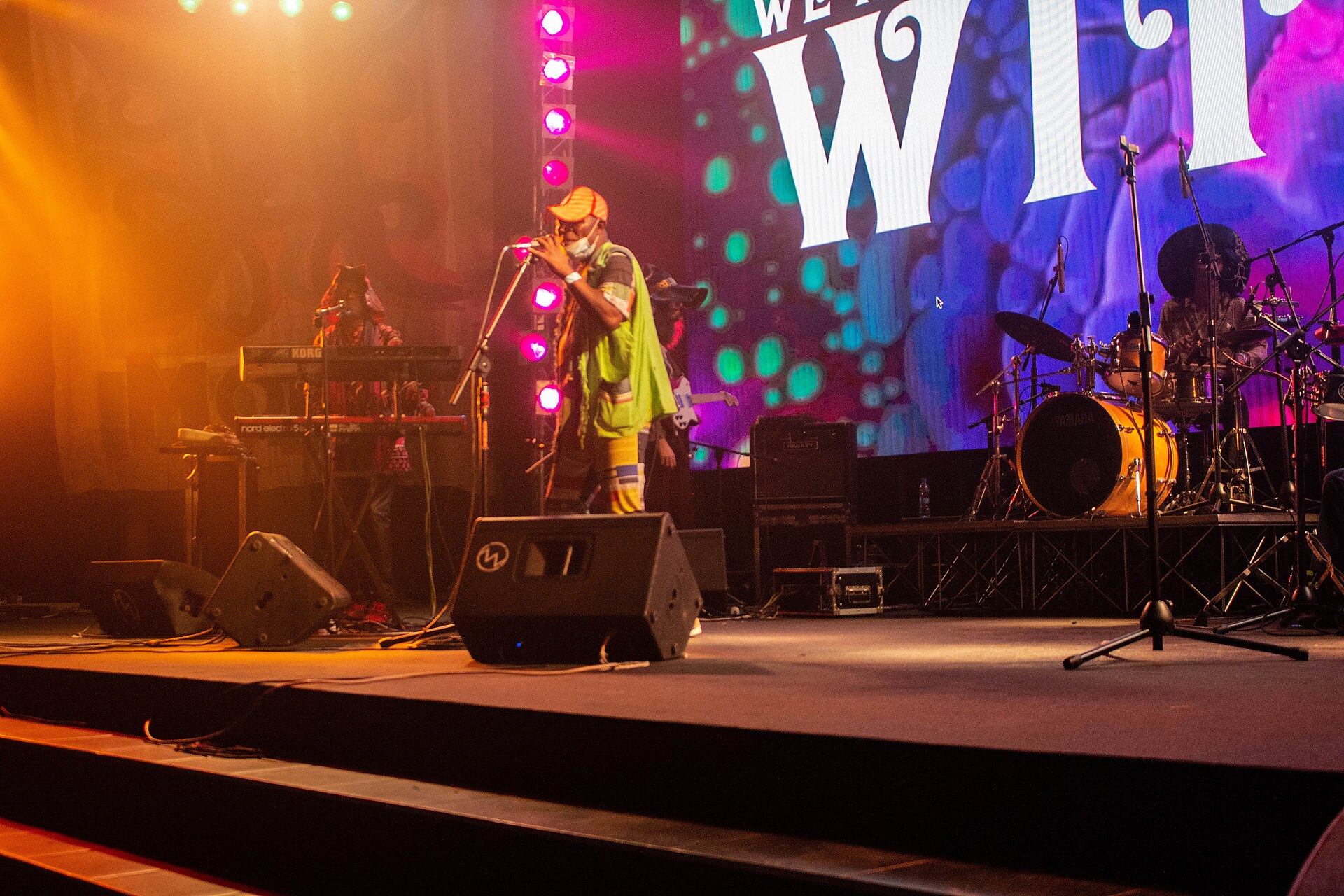
Nobody bought anything. No acquisition, no advance on any document, no price anywhere in the public record. What exists is a licence, and the arresting thing is who granted it. The recorded catalogue of WITCH, the defining band of Zambia’s Zamrock scene, is exploited worldwide today on the strength of a grant from one man rather than from any record company.
Now-Again Records, the Los Angeles reissue label, states on its own site that it “has licensed the WITCH repertoire from the ensemble’s last surviving member, Emmanuel Jagari Canda,” working “in conjunction with Zam Rock pioneer Rikki Ililonga.” That sentence is the entire publicly stated basis for the commercial life of five albums cut in Lusaka between 1973 and 1977. The label spells the surname Canda on that page and Chanda on its release notes, an inconsistency of the kind that runs through this whole file.
Read against the label’s own other documents, the claim does not sit still. On one storefront Now-Again says it owns these masters outright. On another, for the very same release, it says the band owns them and that Now-Again merely administers them. Those are different legal positions, and both statements were delivered by the same company for the same product.

Owns, or administers? The same 2025 release says both#
On 28 November 2025 the label issued a WITCH compilation called Fool’s Ride, catalogue number NA 5291. Its Bandcamp page carries the line “NA 5291 (P)(C) 2025 NOW-AGAIN RECORDS.” That is a claim to the phonogram, meaning the sound recording, and to the copyright in the underlying work, asserted for the label and nobody else.
The same release on Apple Music, album id 1857887077, carries the line “℗ 2025 WITCH, Exclusively Administered by Now-Again Records.” That names the band as the owner of the recording and the label as its administrator. An administrator collects, licenses onward and accounts to an owner. It is not the owner.
Both lines were read on 2 November 2026. Both were delivered by Now-Again. They cannot both be right.
Widen the view to the 1970s albums and a third version appears. Apple’s full catalogue for the band, artist 533280448, carries “℗ 1974 WITCH, Exclusively Administered by Now-Again Records” on Introduction and In The Past; “℗ 1976 Now-Again Records” on Lukombo Vibes; “℗ 2026 Now-Again Records” on an edition of Lazy Bones!!; and “℗ 2012 Now Again Records” on the 2012 editions of four of the same titles. Three mutually inconsistent statements of ownership, across editions of recordings nobody disputes the band actually made.
One of them is impossible on the label’s own evidence. Now-Again’s founder page says “Now-Again started as a reissue imprint in 2002.” A 1976 phonogram cannot have vested in a company that by its own account did not exist for another twenty-six years.
The missing step: the master tapes were sold in the 1970s#
The sharper problem is upstream of all of this, and it comes from Chanda himself.
In an interview published on 24 October 2012 he described falling out with an early manager, said “So we demanded our master tapes back,” and then said something that complicates every credit line above: “We sold the master tapes to Mr. Khuzwayo and signed a 4 year recording contract with Teal Records.” In the same interview he identified the buyer’s company: “Zambia Music Parlour, owned by Edward Khzwayo started as one of the first distributors of records.”
A second interview, published on 19 February 2019, states it independently and flatly: “The master tapes were later sold to Zambia Music Parlour.”
Neither account says the tapes ever came back. This desk found no document of any kind recording a transfer of them from Zambia Music Parlour to Chanda, to the band, or to any estate. A licence from an individual and a sale to a company are not inconsistent in principle, because rights can travel back. But the journey back has to exist somewhere, and here it does not exist in anything published.
There is a loose claim in circulation that Teal Record Company returned the masters to the musicians when it wound down in Zambia, leaving Chanda holding them as the only survivor. That would resolve the question neatly. It could not be located in any document this desk fetched and read, including both interviews in full, so it is not reported here as a fact.
The South African company in the middle#
Teal matters because Now-Again’s own paperwork puts it at the origin of the recordings. The label’s release notes for Introduction say “Original session produced by Teal Record Company.” Its notes for Fool’s Ride go further, naming three 1975 Lusaka singles issued on Teal Record Company and Zambezi Records under catalogue numbers ZTZ 4, ZTZ 6 and ZTZ 9, and recording that “Fool’s Ride / Chifundo” was produced by Teal, cut at Sapra Studios in Nairobi on 21 September 1976 and engineered by Detlef Degener.
Registry data corroborates those label names independently: Lazy Bones!! and Lukombo Vibes on Zambezi as ZTZ 1 and ZTZ 7, the 1977 self-titled album on Teal as WIT 2, the 1973 debut on the band’s own WITCH Records as TW 006.
Chanda says Teal “came from South Africa, not Zimbabwe,” and adds “I believe its sister company is Gallo Records.” That second clause is his belief. No register document was obtained that confirms it, and this piece does not assert it. A 2015 trade history of Zimbabwe’s recording industry records a Teal Record Company established in Salisbury as “a subsidiary label of EMI Records,” and records that in 1980 “Teal bought shares in Shed Studios and changed its name from Teal to Gramma Records.” WITCH’s 1980 album Movin’ On sits on a label called Shed, catalogue SHED 1002. Whether that Shed and those Shed Studios are the same undertaking was not established, and it is flagged here rather than guessed at.
The reunion albums are a completely separate structure#
None of the above touches the band’s new work, which runs on different paper. Partisan Records announced in its own voice: “We’re excited to announce a new label partnership with Desert Daze Sound!” and said “Zango is WITCH’s first new album in 40 years, and will be available worldwide.” Zango, which features the Zambian-born rapper Sampa the Great on “Avalanche of Love,” arrived on 2 June 2023.
The credits point somewhere other than Partisan. Zango, SOGOLO and the singles “Waile,” “Message from WITCH” and “Ain’t Nobody” all carry “℗ Desert Daze Sound.” Partisan is not the named phonogram owner on any of them, and Partisan’s own WITCH artist page states no rights or label relationship at all. The word both parties used is “partnership.” No document reached says whether that means an imprint, a joint venture, a distribution agreement or a licence, and those four things pay artists very differently.
Two further claimants sit in the same catalogue, noted without being chased: “℗ 2021 Sharp-Flat Records” and “℗ 2025 BBE Music,” each on a single. The 1980 and 1984 albums carry “℗ 1980 WITCH” and “℗ 1984 WITCH” with no company named at all.
What could not be established#
Who owns the 1970s masters. The licence is not public, and the gap between the 1970s sale and the present-day grant is undocumented. Consideration: nothing, anywhere, for the Now-Again licence. The only figure Chanda gives in any interview is a 15,000 kwacha loan the band took from Teal in the 1970s to buy instruments, against which, he says, “all the royalties from the records under contract went to offset the loan.” Lazy Bones, he says, “actually sold over 7,000 copies.”
Term, exclusivity and territory: not stated anywhere. The credits are byte-identical across eight storefronts, Zambia’s among them, so there is no visible carve-out for the band’s home market. Reach is not the same thing as a grant.
The compositions, as opposed to the recordings: no publisher or administrator was identified for a single WITCH song. The ASCAP repertory search returned HTTP 403 to this server and the BMI search returned a bot challenge rather than data, so that is a failed check, not a finding. Zambia operates no public company register this desk could reach, so Zambia Music Parlour’s current status is unknown, which is awkward given that the name still appeared as a credited label alongside Now-Again on a 2022 reissue.
What this means for artists#
Three practical lessons sit in this file, and they apply well beyond Lusaka.
First, a credit line is a claim, not a contract, and it is written by whoever uploaded the release. When the same company publishes two different owners for one record on two shops, at least one of those statements is wrong, and an artist relying on either to work out what they are owed is building on sand. If you are signing anything, ask for the phonogram line in writing and ask which entity will be named on it.
Second, the distinction between owning and administering is the whole ball game. An owner keeps the asset. An administrator holds a revocable job. Catalogues from Africa’s 1970s are being reissued at speed, from Zamrock to Ethio-jazz to highlife, and the deals are often described publicly with words like “partnership” that carry no legal content. Amanaz sits in the same position as WITCH, licensed to the same label by surviving members.
Third, chain of title decides who gets paid in forty years. Nobody can say with confidence who owns these five albums because one transfer in the 1970s was never papered in public, and everyone since has built on top of the gap. Keep your own copy of every assignment you sign. The survivor of your band may one day be the only person who can prove what happened.
Now-Again Records has published no licence term, territory or figure, and no party has corrected any credit line described here. If one does, this piece and its deal record will be updated and the change logged.