
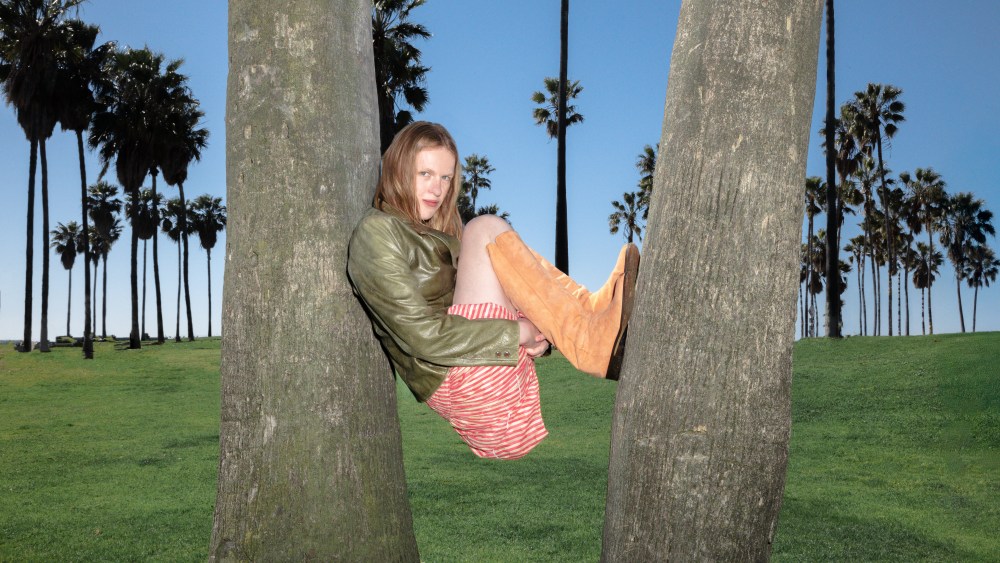
Audrey Hobert is standing on a chair, wearing Groucho glasses and an enormous trench coat and faux-strumming a banjo. She looks 10 feet tall. She moves across the stage as if dancing alone in her bedroom, and she sings every song in her catalog and then plays her biggest hit, “Sue Me,” one more time, bouncing on an exercise trampoline and telling the crowd to put away their phones. After 45 minutes, she vanishes. The house lights come on.
“I wish I could exit my body and watch my show,” the 27-year-old singer says a week before her three-night run in Brooklyn. Today she’s wearing a normal-sized trench coat and clutching a book about Elizabeth Holmes. She’s been on the road since December, and within 10 months, she went from playing for 650 fans at the Music Hall of Williamsburg to three sold-out nights at the Brooklyn Paramount. Related Stories Secuoya Studios Taps Carla Gómez to Lead Latin American Development as Regional Expansion Accelerates (EXCLUSIVE) 'Crew Girl' Renewed for Season 2 at Netflix
In the year since the release of her debut album, “Who’s the Clown?,” Hobert has become one of pop’s most electrifying new acts. Her lyrics are equal parts confessional and funny — she sings of rating Uber drivers, sleeping with exes and taking naughty mirror selfies — and her fast-talking, conversational style has drawn comparisons to early Taylor Swift. Popular on Variety

Naturally, her music is also reminiscent of her childhood friend and collaborator Gracie Abrams, though Hobert’s sound has more of an edge. After both attended college in New York, they moved in together in Los Angeles. Abrams was working on her debut album while Hobert, an aspiring screenwriter, was staffed on a Nickelodeon show. “I never intended to become a songwriter,” she says.
One night it all changed. “Gracie’s cousin came over and was telling us a story and said something that we both found funny,” Hobert recalls. “We repeated it to each other in song, and then sat down that day and wrote a song for fun. Then we just kept playing it.”
Soon, Hobert was a credited writer on half of Abrams’ sophomore album, “The Secret of Us,” a massive breakout hit that sent Abrams on a year-long world tour and left Hobert to her own devices.
“It wasn’t on my mind to sneak off and do this alone,” Hobert says of songwriting. “When she went off to do extensive touring, I just didn’t want to stop. I had been bitten by the bug.”
When she wrote “Sex and the City,” a self-deprecating ballad about her romantic misadventures, she gained the confidence to go it alone. “I was so moved by my own work,” Hobert says. “I knew it was going to course correct my life.”
Hobert believes in the power of manifestation, which she traces back to seeing the self-help tape “The Secret” in her living room as a child. Recently, Hobert wrote down one of her goals 40 times in a notebook. “I don’t feel like sharing what it is,” she says, “but you can probably guess.”
Next year, Hobert hopes to compete for a Grammy in the best new artist category, where her brother, singer-songwriter Malcolm Todd, is also predicted to be nominated. Riding the roller coaster of stardom has been easier with her best friend and sibling strapped in next to her.
“We laugh about how silly it is,” Hobert says of their careers.
But for any contemporary celebrity, it’s a rite of passage to endure the inevitable waves of social media backlash. For Hobert, there was a nasty hate campaign following the August release of her NPR “Tiny Desk Concert,” which was fueled by disparaging comments about her appearance.
“Social media is such a disgusting place,” Hobert says. “Instagram came out when I was in middle school, and I immediately called bullshit on it. I remember friends of mine posting pictures from a Memorial Day pool party that I wasn’t invited to, and I was like, ‘Oh, this isn’t going to work for me.’”
Her solution is to remember that she isn’t defined by what people say on the internet. “Whether it’s positive or negative, it’s not true,” she says. “I don’t need to see mean things about myself. And it’s nice to see nice things about myself, but neither of them are real.”
In February, Hobert will open for Charli xcx on a European leg. She technically hasn’t started writing her sophomore record, but she refuses to put borders on the creative process.
“Whether or not I’m actively writing music, each day is going to inform whatever I say next,” Hobert says. “I would hate to start thinking about my life in terms of cycles.”