

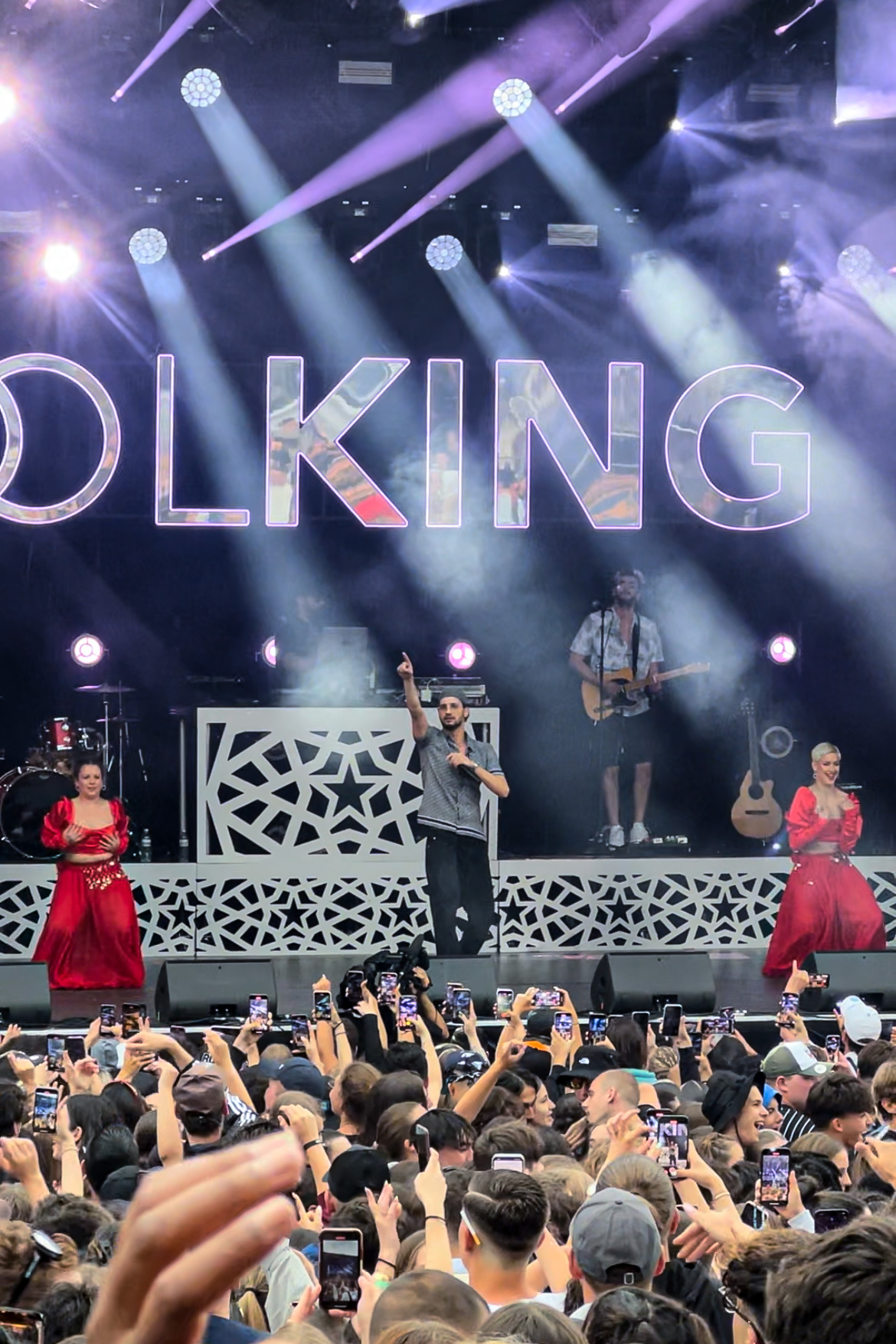
Nine. That is how many of Spotify’s 75 published daily charts have carried at least one African-origin lead artist on every single collection this desk has taken between 16 and 25 September 2026, eight collection dates running, the longest unbroken run in the 28 dates this panel has measured since 13 August. The count comes from this desk’s own african-presence-over-time series, built from Spotify’s daily chart in every market it publishes one for, with each lead artist’s origin resolved through MusicBrainz and this desk’s own roster corrections.
Nine collection dates running, 16 to 25 September, is the longest flat stretch in the series so far.
Show the numbers
| Date | Markets with any African artist |
|---|---|
| 2026-08-13 | 12 |
| 2026-08-24 | 12 |
| 2026-08-17 | 11 |
| 2026-08-20 | 11 |
| 2026-08-21 | 11 |
| 2026-08-22 | 11 |
| 2026-08-31 | 11 |
| 2026-08-27 | 10 |
| 2026-08-28 | 10 |
| 2026-08-30 | 10 |
| 2026-09-02 | 10 |
| 2026-08-25 | 9 |
| 2026-09-01 | 9 |
| 2026-09-04 | 9 |
| 2026-09-07 | 9 |
| 2026-09-16 | 9 |
| 2026-09-17 | 9 |
| 2026-09-19 | 9 |
| 2026-09-20 | 9 |
| 2026-09-21 | 9 |
Source: kworb.net Spotify daily country charts, artist origin from MusicBrainz, retrieved 25 Sep 2026 · download the data

Nine is not a high number by the series’ own standard. Across all 28 collection dates the count has averaged 9.5, and no single date supplies more than 4.5 per cent of the 28-date total, so this is not one outlier day propping up the average the current run sits on. What is unusual is the run length itself. The series has taken five different values, 8 through 12, across 13 separate runs since 13 August. Before this one, the longest run was four collection dates, and that happened twice: at 11 markets, 17 to 22 August, and at 8 markets, the series low, 12 to 15 September. The current run picked the count up by exactly one, to 9, on 16 September, immediately after that four-date low, and it has not moved since.
| # | Markets charting | Run length, collection dates | Run start | Run end |
|---|---|---|---|---|
| 1 | 9 | 8 | 2026-09-16 | 2026-09-25 |
| 2 | 11 | 4 | 2026-08-17 | 2026-08-22 |
| 3 | 8 | 4 | 2026-09-12 | 2026-09-15 |
| 4 | 10 | 3 | 2026-08-27 | 2026-08-30 |
| 5 | 12 | 1 | 2026-08-13 | 2026-08-13 |
| 6 | 12 | 1 | 2026-08-24 | 2026-08-24 |
| 7 | 9 | 1 | 2026-08-25 | 2026-08-25 |
| 8 | 11 | 1 | 2026-08-31 | 2026-08-31 |
| 9 | 9 | 1 | 2026-09-01 | 2026-09-01 |
| 10 | 10 | 1 | 2026-09-02 | 2026-09-02 |
| 11 | 9 | 1 | 2026-09-04 | 2026-09-04 |
| 12 | 8 | 1 | 2026-09-06 | 2026-09-06 |
| 13 | 9 | 1 | 2026-09-07 | 2026-09-07 |
Source: Computed from this desk's registered african-presence-over-time series, retrieved 25 Sep 2026 · download the data
Four of the nine are Spotify’s own African home charts: Nigeria (84.1 per cent African by chart streams on 24 September), Egypt (77.8 per cent), Morocco (45.1 per cent) and South Africa (15.9 per cent). The other five are markets outside Africa where at least one African-origin artist’s own streams reached that country’s daily chart on 24 September: Saudi Arabia (12.1 per cent African by chart streams, seven artists), the United Arab Emirates (3.1 per cent, three artists), Portugal (1.1 per cent, two artists, the Angolan singers Anselmo Ralph and Master Jake), Italy (0.3 per cent, one artist, the Guinean-born, Milan-based rapper Nabi) and France (0.3 per cent, one artist, the Algerian-French rapper Soolking). Those five export markets together carried 343,534 African-origin chart streams on 24 September, the one date inside this run for which this desk has a full market-by-market breakdown.
| # | Name | Type | African artists charting | African chart streams | African share, % |
|---|---|---|---|---|---|
| 1 | Nigeria | African home chart | 35 | 12.74m | 84.14 |
| 2 | Egypt | African home chart | 30 | 4.7m | 77.84 |
| 3 | Morocco | African home chart | 26 | 938,172 | 45.08 |
| 4 | South Africa | African home chart | 22 | 781,311 | 15.86 |
| 5 | Saudi Arabia | non-African export chart | 7 | 168,059 | 12.08 |
| 6 | France | non-African export chart | 1 | 63,039 | 0.34 |
| 7 | Italy | non-African export chart | 1 | 54,511 | 0.34 |
| 8 | Portugal | non-African export chart | 2 | 36,936 | 1.10 |
| 9 | United Arab Emirates | non-African export chart | 3 | 20,989 | 3.10 |
Source: kworb.net Spotify daily country charts, artist origin from this desk's roster, read from this desk's registered spotify-african-share-by-market dataset, retrieved 24 Sep 2026 · download the data
What a stable count does not prove is a stable set of markets. Comparing this desk’s earliest and most recent full export-market breakdowns, 13 August against 19 September, four charts that had carried an African-origin artist, Switzerland, the Netherlands, Belgium and Greece, fell to zero, while Italy went from zero to one. The topline number barely moved across that stretch even as the markets underneath it changed. This desk holds only one full composition snapshot, 24 September, inside the eight-date run that is this piece’s subject, so whether the same five export markets held every one of the eight dates, or one dropped out on a date and a different one filled the ninth slot, is not something the data on hand can settle. That is a limit of this measurement, not a finding about it.
| # | Name | Status | Who carried it on 13 August |
|---|---|---|---|
| 1 | Saudi Arabia | held | Sherine, Mohamed Hamaki, Amr Diab, Cairokee |
| 2 | Portugal | held | Calema, Anselmo Ralph, Shimza, Master Jake |
| 3 | France | held | DopeNation, Soolking |
| 4 | Switzerland | lost | DopeNation, Shimza |
| 5 | Netherlands | lost | DopeNation, Victony |
| 6 | United Arab Emirates | held | Rema |
| 7 | Belgium | lost | DopeNation |
| 8 | Greece | lost | Shimza |
| 9 | Italy | gained | none |
Source: kworb.net Spotify daily country charts, artist origin from this desk's roster, retrieved 19 Sep 2026 · download the data
The robustness check backs the count, not the composition. Dropping the five highest-count dates from the 28-date series only pulls the sum down 21.4 per cent and the mean from 9.5 to 9.1, so the plateau is not an artefact of a handful of unusually strong collection dates elsewhere in the series making a flat stretch look more significant than it is.
| # | Scenario | Rows | Mean | Change in total, % |
|---|---|---|---|---|
| 1 | All rows | 28 | 9.54 | 0 |
| 2 | Excluding the top 1 (2026-08-13) | 27 | 9.44 | -4.49 |
| 3 | Excluding the top 3 (2026-08-13, 2026-08-24, 2026-08-17) | 25 | 9.28 | -13.11 |
| 4 | Excluding the top 5 (2026-08-13, 2026-08-24, 2026-08-17, 2026-08-20, 2026-08-21) | 23 | 9.13 | -21.35 |
Source: Recomputed from african-presence-over-time, retrieved 25 Sep 2026 · download the data
For an independent label weighing whether to spend on an international push off the back of chart presence, the honest reading of this run is stability, not growth. The count of non-African charts carrying an African-origin artist has stopped falling since 16 September, but it has not risen either, and five is a small slice of the 75 charts this panel tracks in total. Before citing a market’s chart appearance as evidence of a sustained international foothold, check whether the same act is still the one carrying it. On the one date this desk can check in full, three of the five export markets were single-artist positions, France entirely Soolking’s, Italy entirely Nabi’s, and a market that concentrated in one act is one release away from falling out of the count altogether.