

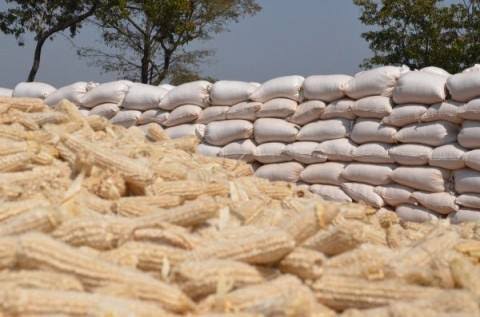
Zambia’s Food Reserve Agency (FRA) is holding a record 3.1 million tonnes of maize in national strategic reserves, a level that executive director Justin Chuunka says puts the country “beyond secure” on food for the first time in its history.
Chuunka announced the milestone during a tour of the Kabuyu satellite depot in Kazungula District, Southern Province.
“Countrywide we have more than three million tonnes and it has never happened in the country where we have three million tonnes, meaning that in terms of national food security, we are beyond secure,” he said.
The stockpile consists of 1.7 million tonnes bought from farmers since May and 1.4 million tonnes carried over from the previous year. The agency procured 1.6 million tonnes in the last marketing season.
The current buying season runs from May 1 to October 31, so the FRA is still purchasing. Grain is being bought from farmers and stored at the same time as a buffer against bad weather.
Storage and community-run depots#
Chuunka said the reserves showed the country’s strengthened capacity to guarantee food availability and protect citizens against hunger. He assured Zambians that they would not face hunger-related deaths, and stressed the FRA’s role in managing the national strategic reserves.
To protect quality, the agency has sent its property director to optimise storage space, while officers on the ground handle the grain. The maize now arriving has been graded as top-tier white maize.
The FRA chief said farmers at Kabuyu were running the depot themselves and creating jobs in their community.
The Kabuyu satellite depot committee zoned the surrounding areas and organised farmers into delivery schedules to keep deliveries orderly. Chuunka urged satellite depot committees across the country to adopt the same community-driven approach to improve operations and bring in more farmers.
Kazungula District Commissioner Elias Siamibila said the committees were set up to give communities the responsibility and authority to run depots on their own.
“The community is able on its own to manage all these activities, and all power is actually vested in the community. That is the essence for which the satellite depot committees were established,” Siamibila said.
Livingstone District Commissioner Eunice Nawa joined the delegation.
The record harvest has stretched the depot’s operations. Depot chairperson Teddy Mulambo said Kabuyu handles about 2,000 bags a day from five agricultural camps. A shortage of empty grain bags has slowed buying, and an estimated 20,000 bags are still sitting with farmers. He appealed for new bags to be supplied urgently before the rains.
Jimmy Maiba, who chairs the Musokotwane camp agriculture committee, said the high yields meant farmers needed more satellite depots to sell their maize easily.
Luapula purchase figures#
In Luapula Province, Provincial Permanent Secretary Prudence Kangwa gave figures for the province. As of September 10, the FRA had bought 3,161,326 bags of 50kg each there, worth 1.096 billion Zambian kwacha (K1.096 billion).
- Total value: 1.096 billion Zambian kwacha (K1.096 billion)
- Amount paid: 328.2 million Zambian kwacha (K328.2 million)
- Farmers paid: 15,575
- Farmers captured: 59,529
Regional food security outlook#
The FRA’s figures match a regional assessment by the Alliance for a Green Revolution in Africa (AGRA). AGRA’s August 2026 Food Security Monitor says Zambia remains relatively food secure, with most of the country in the minimal food insecurity category. Several Southern African Development Community (SADC) countries face worsening conditions in the October 2026 to January 2027 lean season, and Zambia’s position contrasts with theirs.
The report records a 12.7 per cent fall in maize prices from July to August, as harvest arrivals improved supply in markets. Bean prices fell 5.9 per cent and rice 4.2 per cent.
AGRA warns that vulnerable households in parts of western, southern and eastern Zambia could still come under stress. It says market supplies and household purchasing power need to be protected.
The report also warns of a threat from the weather.
“The anticipated persistence of a strong El Niño poses a major threat,” AGRA said.
It warns of below-average rainfall, higher temperatures, lower crop and livestock output, less farm work and falling household incomes in the 2026/27 season.
Zambia’s neighbours are in a weaker position. In Malawi, maize prices rose 3.5 per cent in August and beans 5.8 per cent as supplies stayed tight. Maize prices in Mozambique fell 2.0 per cent, but AGRA says food insecurity remains a concern there because of climate shocks, conflict and supply disruptions. Zimbabwe faces worsening conditions in deficit areas despite an above-average national maize harvest.
AGRA says surplus producers such as Zambia can help ease regional food prices. It warns that disruptions to production, transport or trade could quickly spread shocks across borders.
Chuunka has gone on to tour other satellite depots in the region. Buying continues until the end of October.