

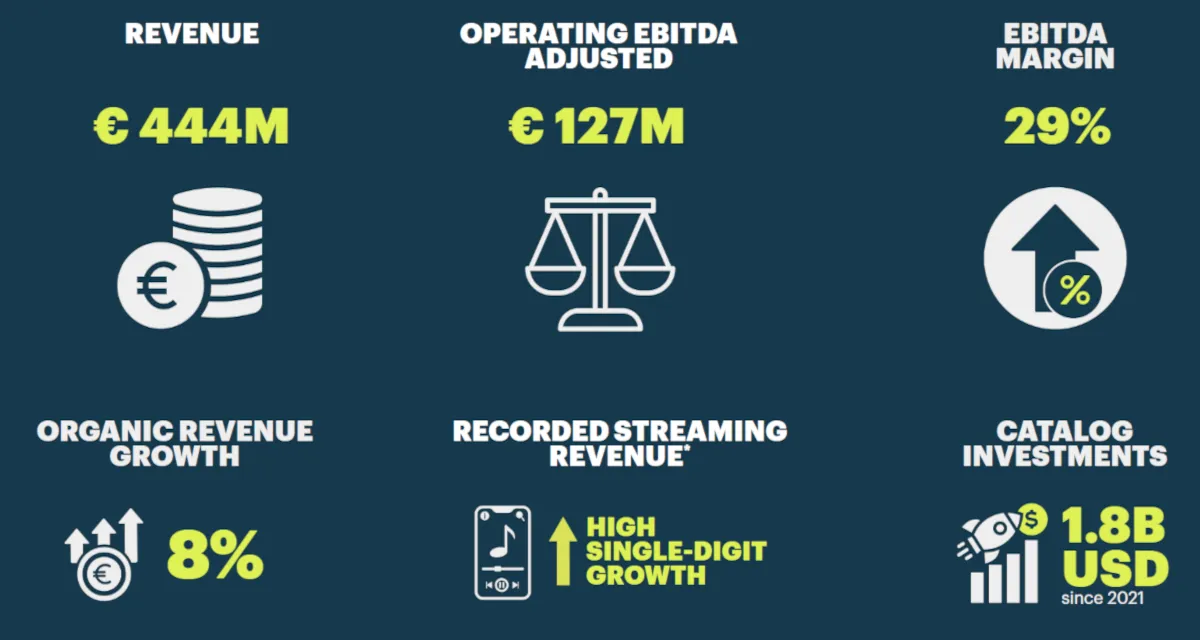
Germany-based BMG reported first-half 2026 revenue of $515 million, a 4.9% year-over-year increase, alongside what it described as its highest first-half investment in music rights in company history.
The Berlin-based Bertelsmann subsidiary said organic revenue rose 8.1% year over year. Operating EBITDA (earnings before interest, taxes, depreciation, and amortization) increased 4% year over year to $147 million (€127 million), with an EBITDA margin of nearly 29%, flat compared with the prior-year period.
Underlying recorded music streaming subscription revenue achieved high single-digit growth during the six-month stretch, according to BMG.
Revenue breakdown#
The largest portion of BMG revenue came from rights and licenses:
- Rights and licenses: $486 million (€419 million)
- Own products and merchandise: $27 million (€23 million)
BMG said its performance largely held steady on a geographic basis.
Geographic performance#
- United States: approximately half of total revenue, unchanged from the first half of 2025
- United Kingdom: $58 million (€50 million), up 9% year over year
- Other European countries, excluding the UK, France, and Germany: $101 million (€87 million), up 13% year over year
Catalog investment and AI#
Deals for the song rights of Jelly Roll, Fuji Music Group, Jet, and others resulted in the highest first-half investment in music rights in BMG’s history, the company said. Since 2021, BMG has deployed around $1.85 billion (€1.6 billion) on catalog acquisitions.
The earnings release made no mention of BMG’s licensing deal with Suno and did not reference generative artificial intelligence (AI), even in a section dedicated to AI. BMG said it is using AI to boost fan engagement, improve productivity, and “activate catalog more effectively.”
“Our first-half results reflect the strength of the business we have built over the past several years,” Coesfeld stated. “Through BMG Next, we have become a more focused, more profitable, digital-first business, one that is better able to invest in artists, songwriters, and music rights for the long term.
“Sustained organic growth, record profitability, and our highest-ever first half investment in music rights give us a strong foundation for the opportunities ahead,” continued the executive, who is set to begin leading Bertelsmann at the start of 2027.