
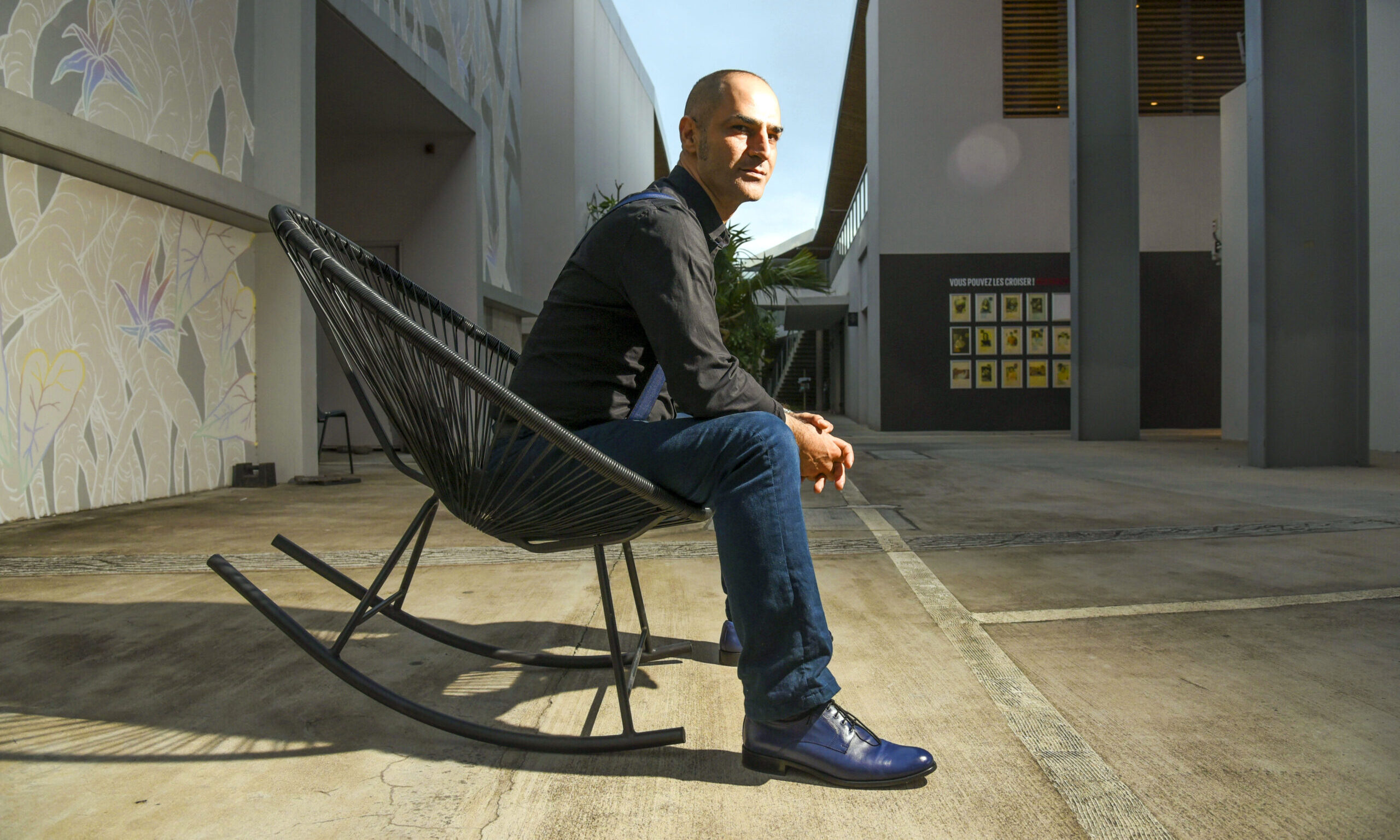
Iranian-born, Réunion-based multimedia artist Arashka will bring his fusion of electronic music, traditional sounds and audiovisual performance to Cape Town, South Africa in September 2026, with a programme spanning community engagements, the Shakti film-concert and solo Arashka Electro performances.
Born Arash Khalatbari in Iran, raised in France and based on the Indian Ocean island of Réunion since 2011, Arashka has developed a practice shaped by music, territory and human connection. Trained as an architect and holding a PhD in urban sociology, he explores links between urbanisation, ancestral traditions and contemporary electronic music. He describes Réunion as his “Axis Mundi”, arguing that any point on a spherical Earth can be considered its centre, and regards the island as a meeting point of African, European, Indian and Asian cultures. That experience informs his view of himself as a “global Creole” and his approach to collaboration.
Arashka’s musical career began in France, where he moved at age 14 during the Iran-Iraq war. He founded Vox Populi in the 1980s, releasing three albums that combined ethnic sounds with industrial elements, before co-founding the trio Ekova in 1994. The group toured extensively, including as a support act for The Cure, while Arashka also worked in sound design for ballet. His collaborations have included musicians from Iran, Kurdistan, India, Japan, West Africa and the Caribbean.
His approach to collaboration is based on creating space for musicians to contribute their own cultural and artistic perspectives. “I almost never work with samples,” he says. “Instead, I try to create a space where ‘the other’ can express themselves as well as I can.”
Shakti film-concert#
That philosophy is central to Shakti, an audiovisual project that emerged from a remote collaboration with Indian vocalist Sukanya Chattopadhyay during the COVID-19 pandemic in 2021. The project explores the concept of sacred feminine energy through music, dance and film, bringing together artists from India, Lithuania and Réunion. Arashka describes it as a “poetic journey about universal feminine power”.
The Shakti film-concert combines Chattopadhyay’s Hindustani classical vocals with Arashka’s electronic soundscapes, field recordings, atmospheric textures and rhythmic elements. Video footage from India, Lithuania and Réunion forms an integral part of the performance, with dancers appearing on screen alongside the music.
One track, ‘Zamin’, features Lithuanian polyphonic singers. The word “zamin”, meaning “Earth” in Persian, Sanskrit and Lithuanian, reflects Arashka’s interest in linguistic and cultural connections between seemingly distant communities.
The project also has personal resonance for Arashka, particularly in relation to the Woman, Life, Freedom movement in Iran. Through Shakti, he explores ideas around femininity, spirituality and empowerment while connecting those themes to wider questions of cultural identity and human experience.
Arashka Electro#
While Shakti is built around contemplation and audiovisual storytelling, Arashka Electro takes a more physical approach. His solo electronic performances are driven by what he calls his “musical passion”, ternary rhythms found across African and Afro-diasporic musical traditions.
The performances draw on rhythms from the Mozambique Channel, the Indian Ocean and the Afro-Arabian coast, incorporating elements of Réunion’s maloya, West African polyrhythms and Persian and Arabian musical traditions. Arashka combines these influences with synthesised sounds, effects, controllers and live instrumentation, creating electronic performances that connect traditional rhythmic structures with contemporary production.
His interest in urban sociology also informs the sound, with layered electronic textures reflecting the energy and complexity of modern cities. Rather than presenting electronic music as detached from human experience, Arashka uses rhythm as a link between technology, movement and traditional musical cultures.
Cape Town programme#
Arashka’s September visit will include performances and educational activities in Cape Town. He describes the trip as an opportunity to engage with African audiences and communities, saying: “I’m already honoured to set foot on the soil of Mother Africa, that was always a dream.”
His Cape Town programme includes:
- a workshop on programming and soundscaping at Bridges for Music Academy in Langa
- a community discussion with women in Oceanview focusing on shakti, spirituality and empowerment
- the Shakti film-concert
- Arashka Electro performances
He sees these engagements as part of a broader belief in music’s ability to create dialogue across cultural and social boundaries. “Right now, there are movements towards identity-based isolationism all over the world,” Arashka says. “I suggest that we, artists, focus on our similarities, on everything we have in common, rather than on what divides us.”
His current collaborations include an online project with Malian ngoni player Moussa Kanouté. He is also interested in incorporating the African mouth harp, known as the goura, into future projects.
Arashka’s Cape Town programme runs from 17 to 24 September 2026. The programme presents two contrasting sides of his work: the contemplative, cinematic world of Shakti and the rhythm-driven energy of Arashka Electro.