
Over four decades ago, a young woman from Ouidah, Benin, picked up a microphone and did something deceptively simple: she sang. But she did not sing to make herself more acceptable to the world. She did not erase her accent, dilute her identity, abandon her language, or distance herself from the culture that had shaped her. She stood firmly in who she was, and invited the world to meet her there.
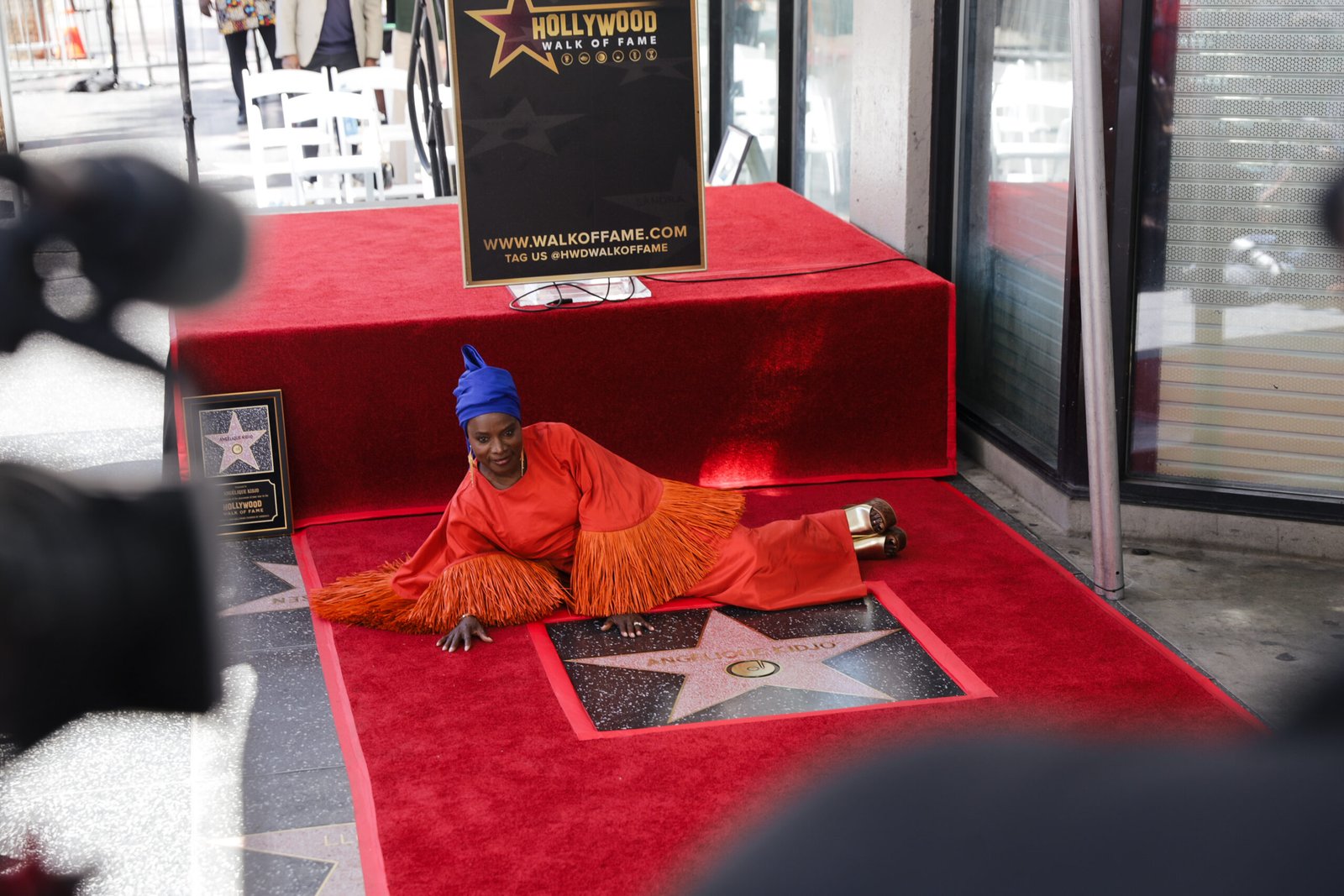
The world did more than listen; it heard her, it felt her, it recognized her; and eventually, it celebrated her. Today, as Angélique Kidjo becomes the first and only Black African artist to receive a star on the Hollywood Walk of Fame, the significance of this moment extends far beyond Hollywood Boulevard. This is not simply the story of an extraordinary musician receiving one of the entertainment industry’s most visible honors. It is the story of an African woman who spent decades proving that authenticity is not a limitation to global success, it can be its greatest source of power.
Her journey matters because it reminds us of something the world too often forgets: talent is universal, but opportunity is not. Talent exists in every village, every city, every country and in every child who dares to dream. But access to the stages where that talent can be seen, heard and celebrated has never been equally distributed. Angélique did not simply cross that divide herself, she widened the path for others.

Not only did she carry Benin with her, but she also carried African rhythms, languages, history, joy and memory into rooms where Africa was not always expected to be represented on its own terms. And she showed generations of Africans and people of African descent that you do not have to become less of yourself to become more visible to the world.
You can speak your language and still be understood. You can honour where you come from and still reach everywhere. You can remain deeply rooted and still become global.
That is the deepest meaning of the star being placed beneath her name today. It is not the beginning of Angélique Kidjo’s stardom, it is the world finally making permanent what millions have known for decades.
She was already a star. Today, Hollywood simply made it visible.
Angélique Kidjo was born on July 14, 1960, in Ouidah, Republic of Dahomey, now Benin. She grew up in Cotonou in a large family with 10 children. Kidjo’s life was shaped by two major cultural traditions. Her father was Fon from Ouidah, while her mother was Yoruba. Her
mother, Yvonne, was a choreographer, theatre director and performer, while her father was a musician. That combination of music, theatre, dance and West African cultural traditions influenced Kidjo’s career path.
She started singing at an early age. At six, she was already performing with her mother’s theatre troupe. At school, Kidjo joined a band called Les Sphinx, and as a teenager she gained national attention with her interpretation of Miriam Makeba’s “Les Trois Z”, which
became a radio hit in Benin. Her passion for music was there. Alongside Beninese and Yoruba traditions, she was used to the music of Miriam Makeba, Hugh Masekela, Fela Kuti, James Brown, Jimi Hendrix, Stevie Wonder, Santana, Manu Dibango and others.
At 20, Kidjo recorded her debut album, Pretty, with Cameroonian singer and producer Ekambi Brillant and her brother Oscar Kidjo. The album, released in the early 1980s, produced songs including “Ninivé” and “Pretty” and turned her into a young star across West
Africa. But political instability in Benin made it difficult for her to pursue an independent artistic career at home. In 1983, she moved to Paris.
In Paris, Kidjo studied music and worked as a backup singer. While learning music, she met musician and producer Jean Hébrail, whom she married in 1987. Kidjo eventually fronted the Euro-African jazz-rock group Pili Pili, led by Dutch musician Jasper van’t Hof. She recorded three albums with the group before beginning her solo career in earnest. She released her
first international album Parakou in 1989.
Her breakthrough came with Logozo, released in 1991 on Island Records. Produced by Joe Galdo, the album fused Beninese rhythms with Afro-funk, reggae, samba, salsa, gospel, jazz, zouk, makossa and other influences. It featured saxophonists Branford Marsalis and
Manu Dibango and became a major international success, reaching No. 1 on Billboard’s World Albums chart. The videos for the singles “Batonga” and “We-We” helped introduce Kidjo’s striking visual identity and sound to international audiences.
She followed the Logozo album with Ayé in 1994. The album was recorded partly at Prince’s Paisley Park Studios in Minnesota and partly in London. Its standout song, “Agolo”, became one of the defining recordings of Kidjo’s career. The song’s video earned her first Grammy nomination, while its environmental message gave her music a social dimension. With Femi Kuti in 1996, Kidjo returned physically and musically to Benin. Working with Jean Hébrail, she travelled throughout the country to record traditional rhythms and incorporate them into the album. Fifa, which means ‘Peace’ in Fon, featured ‘Wombo Lombo’, one of her major African hits, and ‘Naima’, a collaboration with Carlos Santana written for her daughter whom she gave birth to in 1993.
From there, Kidjo used her albums as musical maps of the African diaspora. Oremi (1998) examined connections between African music and American R&B; Black Ivory Soul (2002) explored the historical and musical links between Benin and Bahia, Brazil; and Oyaya!
(2004) moved through African, Afro-Cuban and Brazilian sounds. Her 2007 album Djin Djin marked another major turning point. Built around her Beninese roots but featuring an international cast including Carlos Santana, Alicia Keys, Branford Marsalis, Josh Groban, Peter Gabriel and Ziggy Marley, the album earned Kidjo her first Grammy Award, for Best Contemporary World Music Album.
Kidjo’s work has consistently treated music as a form of cultural memory. Her albums have moved between Africa, the Americas, Europe and the Caribbean while maintaining a strong connection to Benin. On Eve (2014), she focused particularly on African women and
incorporated women’s vocal groups from Benin and Kenya. The album won the 2015 Grammy for Best World Music Album. Sings (2015), recorded with the Orchestre Philharmonique du Luxembourg, won her another Grammy in 2016. The project revisited songs from across her career alongside pieces connected to the broader African diaspora, including “Malaika” and Carlos Santana’s “Samba Pa Ti”.
In 2018, she released Remain in Light, her track-by-track reimagining of Talking Heads’ influential 1980 album. The original record was influenced by West African music and Fela Kuti’s Afrobeat. Kidjo’s version reclaimed the African elements, bringing them back through
an African artist’s voice.
She then released Celia in 2019. The album was a tribute to Cuban singer Celia Cruz. Kidjo had encountered Cruz’s music as a child in Benin and later discovered a connection between them. Many of the songs Cruz performed carried Yoruba traditions from West Africa
across the Atlantic. Kidjo described Cruz as a “long lost sister” from the other side of the world. Celia won the 2020 Grammy for Best Global Music Album. Kidjo’s 2021 album Mother Nature brought her into direct conversation with a younger generation of African artists. The album featured Yemi Alade, Mr Eazi, Salif Keita, Burna Boy, Sampa the Great, EARTHGANG and others and addressed climate change, freedom, equality and Africa’s future through a contemporary sound. It won the 2022 Grammy for Best Global Music Album, giving Kidjo her fifth Grammy and establishing her as the record-holder for the most Grammy wins in the Global Music Album category.
Kidjo’s artistic ambitions have continued to expand. She collaborated with trumpeter Ibrahim Maalouf on Queen of Sheba, a project combining African rhythms, Middle Eastern influences and contemporary jazz. She has also worked with artists and composers ranging from Philip Glass and the Kronos Quartet to Peter Gabriel, Alicia Keys, Bono, John Legend, Youssou N’Dour and many others.
In 2026, she released HOPE!!, her 18th album. Dedicated to her late mother, the project turns grief into an argument for joy, resilience and human connection. It features Pharrell Williams, Quavo, Ayra Starr, Davido, Nile Rodgers, Charlie Wilson, IZA, PJ Morton and
others. Kidjo has described hope as central to her mother’s philosophy and to her own belief in music’s ability to restore humanity.
Beyond music, Kidjo has spent decades using her platform for social change. She is a UNICEF Goodwill Ambassador and founded the Batonga Foundation, which supports the education, leadership and economic empowerment of girls and young women in Africa. Her
advocacy has made her artistic legacy inseparable from her humanitarian work.
In 2023, she received the Polar Music Prize, joining a distinguished list of recipients including Paul McCartney, Stevie Wonder, Miriam Makeba, Joni Mitchell and others. Now, in August 2026, her journey reaches another landmark. Kidjo is being honoured with the 2,854th star on the Hollywood Walk of Fame in the Recording category, becoming the first African musician and first Black African to receive the
honour. The recognition places her permanently onto one of the world’s most recognisable cultural landmarks.
Trying to place Angélique Kidjo’s music inside one genre has always been difficult. Across more than four decades, she has moved between traditional Beninese music, funk, jazz, salsa, soul, reggae, Afrobeat and contemporary Afropop. Yet, even at her most
experimental, Africa has remained at the centre of her work. Her recording career began in 1981 with Pretty, an album made with her brother Oscar Kidjo. After moving to Paris, she released Parakou in 1989, but it was Logozo, released two years later, that introduced her to a much wider international audience. The album included “We We,” “Logozo,” “Malaika” and “Batonga,” one of the most significant songs in her catalogue.
“Batonga” carried a message that went beyond music. Kidjo had used the word as a response to people who believed girls did not belong in school. Years later, it inspired the name of the Batonga Foundation, the organisation she created to support the education and
empowerment of girls and young women in Africa. Her international rise continued with Ayé in 1994. Its standout track, “Agolo,” paired vibrant percussion with a warning about the destruction of the environment. The song became one of her most recognisable releases, while its music video earned a GRAMMY nomination.
The album also featured “Adouma,” which remains an important part of her live performances. For Fifa in 1996, Kidjo returned to Benin and travelled around the country recording traditional singers, instruments and rhythms. The process gave the album a strong connection to home, even as its sound remained accessible to listeners outside Africa. “Wombo Lombo,” with its infectious rhythm and memorable choreography, became one of her biggest international songs. The record also included “Shango” and “Naïma,” written for
her daughter.
By the time she released Oremi in 1998, Kidjo was exploring the relationship between African and African American music more openly. Working with musicians such as Branford Marsalis and Cassandra Wilson, she brought soul, jazz, gospel and hip-hop influences into
her sound. Her interpretation of Jimi Hendrix’s “Voodoo Child (Slight Return)” was especially striking, not because she tried to reproduce the original, but because she reshaped it through her own voice and musical background.
This conversation between Africa and its diaspora became even more central to her next projects. On Black Ivory Soul in 2002, she explored the cultural links between Benin and Brazil, collaborating with Brazilian musicians including Gilberto Gil and Carlinhos Brown.
Dave Matthews also appeared on “Iwoya.” She then turned towards Caribbean and Latin sounds on Oyaya! in 2004, bringing together African rhythms, salsa, calypso and reggae.
In 2007, Djin Djin opened another major chapter in her career. It was one of her most ambitious collaborative projects, bringing together Alicia Keys, Peter Gabriel, Carlos Santana, Josh Groban, Joss Stone, Ziggy Marley, Amadou & Mariam and Branford Marsalis.
Alicia Keys and Marsalis appeared on the title track, Peter Gabriel joined her on “Salala,” and Josh Groban and Carlos Santana contributed to “Pearls,” a song addressing the experiences of women affected by war and displacement.
Djin Djin earned Kidjo her first GRAMMY Award in 2008, winning Best Contemporary World Music Album. The award confirmed what her growing international audience already understood: her collaborations were never simply about assembling famous names. She
used them to create meetings between different cultures, generations and musical traditions. Her 2010 album, Õÿö, looked back at the songs and artists that shaped her childhood. Kidjo revisited music associated with Miriam Makeba, James Brown, Otis Redding and Curtis Mayfield, among others. Bono and John Legend joined her on a lively version of Mayfield’s “Move On Up,” while Dianne Reeves and trumpeter Roy Hargrove also contributed to the album.
After the live album Spirit Rising in 2012, Kidjo released Eve in 2014. Named after her mother, the project celebrated African women through songs recorded with women’s choirs from several countries. Nigerian singer Aṣa, Dr. John, the Kronos Quartet and Rostam
Batmanglij were among the contributors. The album, which included “Shango Wa,” “Eva” and “Bana,” won the GRAMMY for Best World Music Album. Rather than repeat the same formula, Kidjo followed Eve with an orchestral project. Recorded with the Orchestre Philharmonique du Luxembourg, Sings reworked songs from her catalogue through symphonic arrangements. It was a bold experiment, but one that allowed the strength of her melodies to emerge in a different setting. The album brought her another GRAMMY Award in 2016.
Her willingness to revisit familiar music from a new angle continued with Remain in Light in 2018. Kidjo reinterpreted the full Talking Heads album of the same name, drawing attention to the African rhythms that had influenced the original record. With contributions from Tony Allen, Ezra Koenig and Blood Orange, she transformed tracks such as “Once in a Lifetime,”
“Born Under Punches” and “The Great Curve” rather than treating them as straightforward
covers.
A year later, she paid tribute to Cuban icon Celia Cruz with Celia. Kidjo approached Cruz’s repertoire from West Africa, highlighting the African roots still present in Afro-Cuban music. Working with musicians including Tony Allen, Meshell Ndegeocello and Benin’s Gangbé
Brass Band, she reimagined songs such as “Quimbara,” “Bemba Colorá” and “La Vida Es un Carnaval.” The project won Best World Music Album at the 2020 GRAMMY Awards.
On Mother Nature, released in 2021, Kidjo turned towards a younger generation of African and diasporic artists. Burna Boy joined her on “Do Yourself,” Yemi Alade appeared on “Dignity,” Sampa the Great contributed to “Free & Equal,” and American hip-hop duo
EarthGang featured on “Take It or Leave It.” One of the album’s defining moments was “Africa, One of a Kind,” featuring Mr Eazi and incorporating the unmistakable voice of Salif Keita.
By bringing together artists from different generations, the song reflected the wider purpose of the album: to present African music as a continuing conversation rather than something divided between the old and the new. Mother Nature addressed climate change, racism, women’s rights and African unity without losing Kidjo’s characteristic energy. It won Best Global Music Album at the 2022 GRAMMY Awards, becoming the fifth GRAMMY-winning project of her career.
That same year, she released Queen of Sheba with Lebanese-French trumpeter Ibrahim Maalouf. Inspired by the meeting between the Queen of Sheba and King Solomon, the seven-part work combined Kidjo’s voice with Maalouf’s jazz trumpet and elements drawn
from African and Middle Eastern music. It later received a GRAMMY nomination for Best Global Music Album.
Kidjo’s influence can also be heard in the work she has done outside her own albums. She appeared alongside Damian Marley on Burna Boy’s “Different,” from the 2019 album African Giant. She also collaborated with Yemi Alade on “Shekere,” which drew from Kidjo’s earlier song “Batonga.” Over the years, her list of collaborators has extended from Philip Glass, Peter Gabriel and Carlos Santana to Yo-Yo Ma, MHD, Davido, Fally Ipupa and the Soweto Gospel Choir.
Her latest album, HOPE!!, released in April 2026, continues this intergenerational approach. Dedicated to her late mother, the album is built around hope, joy and the ability to keep moving through grief. Instead of looking backwards, however, Kidjo surrounds herself with
artists who represent different corners of today’s global music scene.
Pharrell Williams and Quavo join her on the opening track, “Bando,” while Ayra Starr appears on “Aye Kan,” a song about the need for honest communication. “Fall On Me” is a warm duet with PJ Morton, and “Oyaya” brings together Kidjo, Nile Rodgers and Brazilian
singer IZA. Elsewhere, Dadju appears on “Superwoman,” Diamond Platnumz joins her on “Kakua,” and Davido features on “Joy.” “Nadi Balance” brings Kidjo together with Fally Ipupa, The Cavemen and Sheila Maurice-Grey, while Charlie Wilson and the Soweto Gospel Choir also contribute to the album. Kidjo closes the project by returning to “Malaika,” one of the songs from her early international career, this time performed with Florent Pagny in memory of her mother.
From “Batonga,” “Agolo” and “Wombo Lombo” to Celia, Mother Nature and HOPE!!, Kidjo has never allowed her catalogue to stand still. Each album has opened another conversation: between Benin and Brazil, Africa and the Caribbean, traditional music and
electronic production, orchestras and percussion, established icons and emerging stars.
That sense of movement may be the most consistent element in her discography. Kidjo has spent her career crossing borders, but she has never lost sight of where the music begins.
Today, Hollywood honours her with one of its highest recognitions, and an entire continent stands with her, celebrating with immense pride, love, and joy.
The Nigerian artists are ready to take over the world with their unique sound.
In an exclusive interview with Rolling Stone Africa, chart-topping Nigerian singer, songwriter, and producer Kunmie shares the story behind his new album, ’22’, and his decision to leave home at 16.
How the Franco-Congolese artist transforms love, spirituality and his roots into a body of work that resonates across the world
By providing your information, you agree to our Terms of Use and our Privacy Policy. We use vendors that may also process your information to help provide our services.