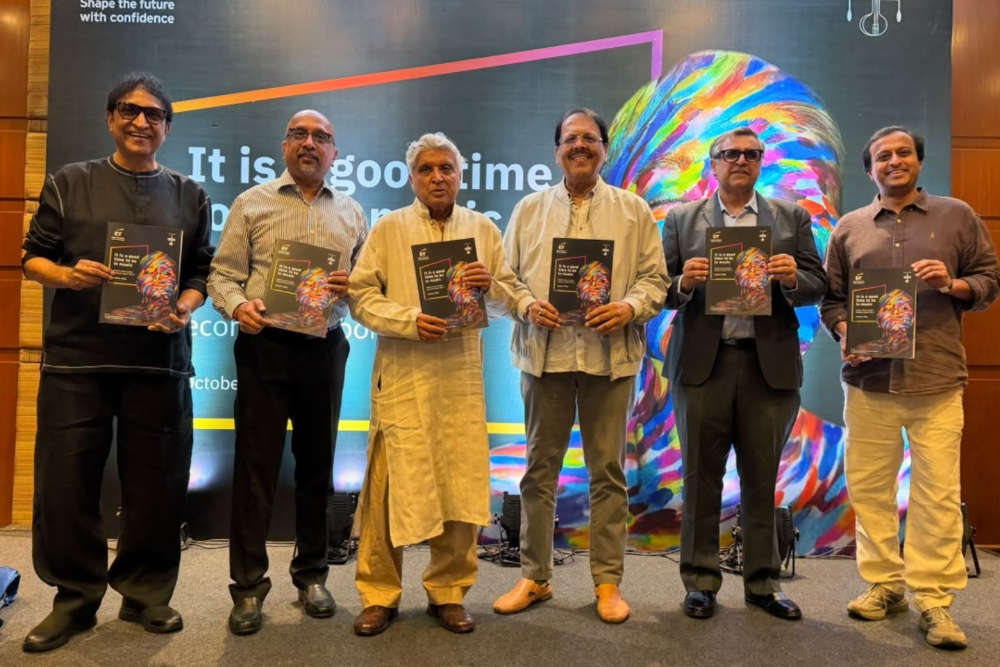
India’s music sector generated an estimated INR17,400 crore ($1.8 billion) in economic activity in 2025, 45% more than two years earlier, according to a new study by EY backed by the Indian Performing Right Society (IPRS). INR is the Indian rupee. Growth in listening is strong, but the report questions how much of that value reaches the people who make the music.
Digital platforms accounted for 52% of that value. Combined label and publishing revenue reached a record INR5,433 crore ($563 million) in 2025, up from INR4,938 crore ($512 million) in 2023. Publishing and performance income rose 79% over the same period, from INR628 crore ($65 million) to INR1,125 crore ($117 million).
Streaming, jobs and live music#
Indians streamed close to six trillion tracks last year. Independent artists accounted for 43% of digital listening, up from under 35% in 2023. The report links the shift to growing demand for regional-language and artist-driven music.

The report, titled “It Is a Good Time to Be in Music: India’s Music Creator Economy Report Vol. 2,” also found that jobs in the organized segment rose 50% to between 60,000 and 70,000. Annual output of original songs climbed to between 22,000 and 27,000.
Live music is also expanding. India staged more than 130 days of concerts in 2025 that each drew over 10,000 people, double the 65 recorded in 2023.
A survey of more than 5,900 users of the streamer JioSaavn, conducted with the company and focused on Gen Z habits, found that music runs through the day. Some 88% listen for at least an hour daily. The most common listening occasions were:
- Travel: 85%
- Relaxing: 76%
- Work: 56%
Studying also featured strongly.
Global standing and paying listeners#
Scale has yet to translate into global clout. India slipped one place to 15th in the recorded music revenue rankings of the International Federation of the Phonographic Industry (IFPI) and sits 23rd for music collections under the International Confederation of Societies of Authors and Composers (CISAC).
- Music revenue per head: $0.40 in India, against $44.70 in the United States
- Indians who streamed music in 2025: 233 million
- Of those streamers, paying subscribers: 14 million to 16 million
Creators’ earnings and rights#
Creators’ views are mixed. While 75% believe there are more opportunities than before, 76% say those openings are getting harder to exploit. The report cites more platforms, direct reach and overseas audiences alongside unpredictable income, a fight for discoverability, complicated rights administration, higher marketing spend and new risks from artificial intelligence (AI).
Lyricist and screenwriter Javed Akhtar, speaking at the launch, said the figures left him “very depressed.” Of the roughly INR5,000 crore ($518 million) that reaches the production side, he estimated that composers, lyricists and singers receive less than INR1,000 crore ($104 million). “So something is seriously wrong even today. Seriously wrong,” he said.
The report puts licensing compliance among eligible businesses at around 4%, the same figure Akhtar cited for hotels, restaurants, bars and events. He said he had proposed to the IPRS board that the government add a question on royalty payments to India’s goods and services tax (GST) form. “So, it’s only lack of intention. Lack of intention,” Akhtar said.
“Could you imagine that someday you would need to patent the voices?” Akhtar asked. He added that the family of the late singer Kishore Kumar receives nothing from the many songs now made in the singer’s voice, and called for new international rules to deal with AI.
Reform proposals and global context#
Ashish Pherwani, partner and media and entertainment leader at EY India, said: “India’s music economy is creating significant value, but its long-term success will be measured by how effectively that value reaches creators. Strengthening monetization avenues, rights management and export capabilities through creator education can help translate rising consumption into sustainable growth for the entire ecosystem.”
The report’s wish list includes:
- Better rights awareness among creators
- Clearer royalty payouts
- Simpler compliance for shops, venues, events and public spaces
- A one-stop licensing window and set rate cards where practical
- An export promotion council dedicated to music
- Closer work between government and industry, more regulatory certainty and formal training in music creation and management
Vasant Sangeet Dwar, India’s first single-portal system for licensing public performances, went live in February 2026.
Lily Pandeya, joint secretary at India’s Ministry of Culture, said: “India possesses a unique opportunity to emerge as one of the world’s leading music markets and cultural exporters. By nurturing talent across languages, regions, and genres, encouraging innovation while safeguarding creators’ rights, and building stronger bridges between culture and commerce, we can unlock the full potential of India’s music creator economy.”
The findings arrive alongside CISAC’s 2026 Global Collections Report, published in the organization’s centenary year, which showed music creator royalties worldwide up 11.9%. Digital collections rose 27.9% and now make up 45.6% of the total, while live and background music became creators’ second-biggest income source globally.
Youssou N’Dour, vice-president of CISAC, said India’s music scene mirrors a worldwide shift in which creators are reaching audiences at unprecedented scale. “The future of the industry will depend on ensuring that creators have the knowledge, rights and opportunities needed to build sustainable careers and continue enriching our societies through music,” he said.
For a sense of what an export push could deliver, the report points to South Korea, where K-pop generated more than $3 billion in overseas music-led revenue in 2025.