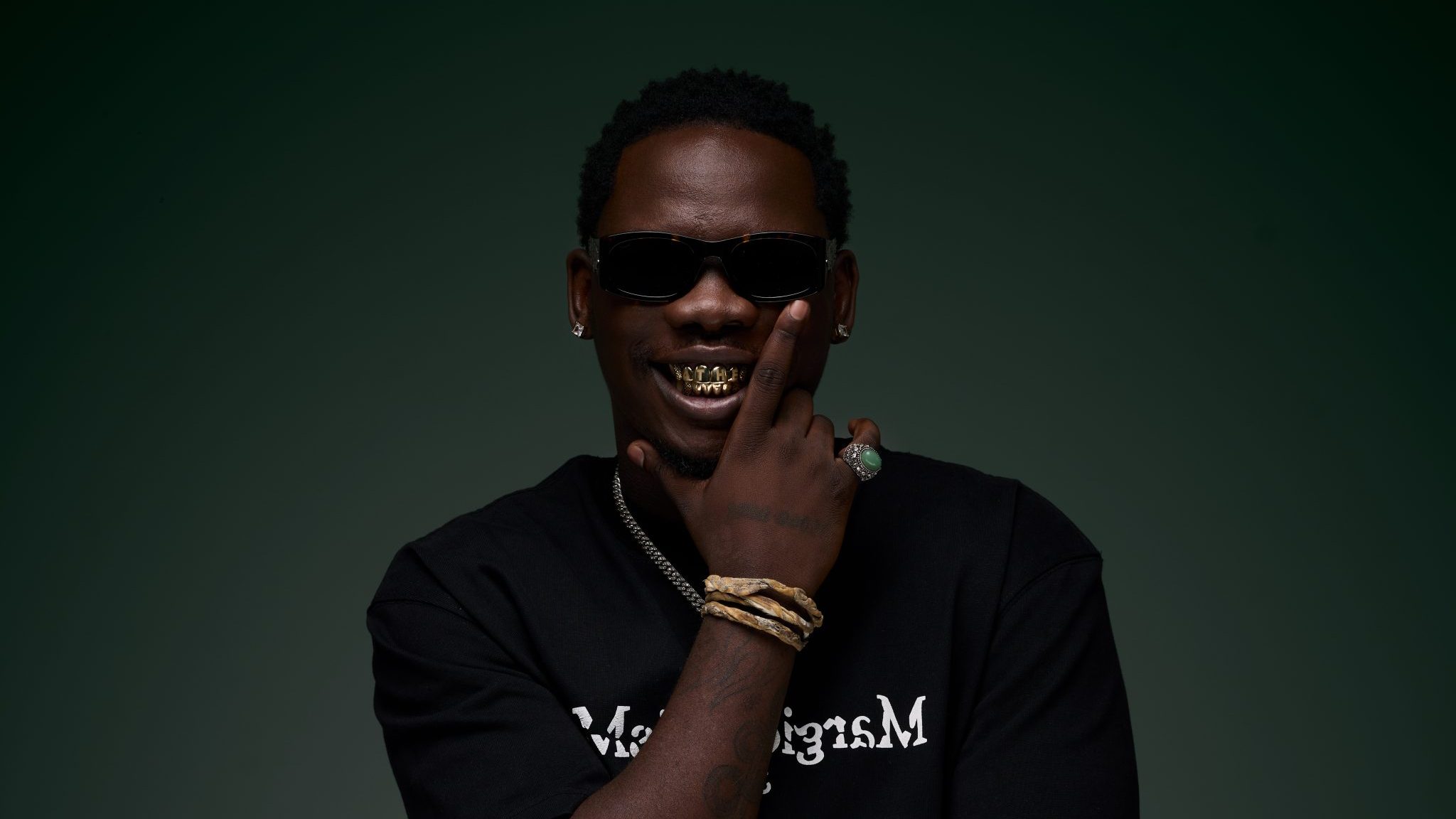
For seven years, every rights registry entry for a Dadju album has carried the same name: Capitol Music France, a Universal Music Group imprint. For almost that same seven years, the actual recording-copyright line on his releases, the small “P” mark that names who controls the master recording, has carried a different name almost every time: Amaterasu Prod, a company that did not exist until six months before his debut solo album came out, and whose president is Dadju himself.
That is not a contradiction so much as a pattern this desk could document but not fully explain, and it is worth walking through carefully, because the distance between “who the registry names as the label” and “who the law actually recognises as controlling a recording” is one of the places where artists’ understanding of their own deals most often goes wrong.
What the paper trail actually shows#
France’s official companies gazette, BODACC, records a company called Amaterasu Prod, a SAS (a French simplified joint-stock company) with the registration number (SIREN) 829649235, incorporated on 16 May 2017 with its activity dated from 29 April 2017. The filing names Dadju Nsungula, Dadju’s legal name, as the company’s president. A second filing, from December 2024, records the appointment of a director general, Sania Ramdane, alongside him.

Six months after that company was registered, Dadju released his debut solo album, “Gentleman 2.0,” in November 2017. MusicBrainz, the open rights-and-release registry this desk checked, lists the label on that release as Capitol Music France. That is the pattern that holds, with variations, across everything that followed: his second album, “Poison ou Antidote,” is split in MusicBrainz’s own records between Capitol Music France and Polydor depending on which edition you look at; his third, “Cullinan,” released in 2022, again lists Capitol Music France.
But when you look at the phonogram line, the copyright credit that Apple’s iTunes catalogue carries for the actual audio file being sold, almost none of those releases name a Universal company at all. “Christina,” a 2018 single, carries the copyright line “Amaterasu.” “Poison,” the lead single of his second album, carries “Amaterasu Prod,” as does the album itself across its 2019 to 2021 editions, and the “Grand bain” single with Ninho, and the entire “Cullinan” album. There is one partial exception: a November 2022 single, “Cullinan: Gelee Royale (Partie 1),” briefly carries a joint credit, “Amaterasu / Capitol Music France,” before the follow-up EP four months later reverts to Amaterasu alone. His February 2024 joint album with Tayc, “Heritage,” carries no Universal credit whatsoever; its phonogram line reads “Amaterasu Prod / Good Mood Publishing / H24,” and MusicBrainz’s own label field for that release names Play Two, a label associated with Tayc, not any Universal imprint.
Put plainly: the public registry that fans, playlisters and researchers typically check says Universal. The copyright line on the product people actually buy or stream usually says Dadju’s own company.
What this does, and does not, prove#
It would be a mistake to read this as evidence that Universal has no stake in these recordings, and this desk is not making that claim. A phonogram credit naming an artist’s own furnishing company is common even inside major-label deals; it can reflect that the artist’s company is the formal supplier of the recording to the major’s distribution and marketing machine, while the underlying rights, or a long-term exclusive licence over them, still sit with the major in ways that do not show up on a retail credit line. Distribution deals, exclusive licences and full-on signings can all produce a version of this pattern, and the public metadata alone cannot distinguish between them.
What can be said with confidence is narrower but still meaningful. No contract between Dadju, Amaterasu Prod, Capitol Music France, Polydor or Universal Music France was available to this desk, so the legal character of the arrangement, licence, distribution deal, or something else, is not established. No consideration, no advance, royalty rate, licence fee or equity figure, appears in any source checked, so no amount is reported here. And the registries do not even fully agree with each other: MusicBrainz’s own entries for “Poison ou Antidote” name two different labels for releases dated the same day, which is a reminder that these registries are maintained by many contributors and are not themselves a legal record of ownership.
This desk also deliberately excluded Dadju’s more recent, collaborative work from the claim. A 2026 single, “Superwoman,” is primarily credited by MusicBrainz to Angelique Kidjo, with Dadju as a featured artist, on a Parlophone and Warner Music France credit, not a Universal one; because that release is led by another artist, it says nothing about Dadju’s own arrangement and was left out of this record’s scope entirely, rather than stretched to fit a tidier story.
What this means for artists#
The lesson here is not about Dadju’s specific deal, which this desk cannot fully characterise from public documents alone. It is about the gap between the credit line a fan sees and the contract an artist actually signed, and why that gap matters to anyone building a career inside a major-label system.
An artist’s own furnishing company appearing on a phonogram credit is not, by itself, proof of ownership or control. It can be the product of a distribution agreement that leaves the underlying masters with the major for the life of the deal. It can also be the product of a genuine licence arrangement where the artist’s company really does retain the masters and simply pays Universal for marketing and distribution muscle. Those two outcomes look identical to the public, and they are financially and legally very different for the artist. If you are negotiating a deal that will put your own company’s name on the copyright line, the only way to know which of those two outcomes you are getting is to read the actual rights grant language in your contract, specifically the duration of any licence, whether it is exclusive, and what happens to the masters at the end of the term, rather than to take comfort from whose name appears on a retail credit.
It is also worth noting how much public information genuinely cannot answer. Streaming platforms, registries and retailers are not required to display, and often do not display, the actual chain of title behind a recording. An artist, a manager, or a journalist trying to work out who controls a catalogue from public sources alone, as this desk did here, will reliably hit a wall at exactly the point where it matters most: the money and the legal grant. That wall is not a flaw in any one registry. It is a structural feature of how recorded-music rights are reported, and it is one more reason artists need their own contract, not the internet, to answer the question of who actually owns what they made.
The full documentation, including the BODACC filings, the release-by-release registry entries and the complete source list, is in the deal sheet for this record.